Space and Physics
 PUBLISHED
 3
3


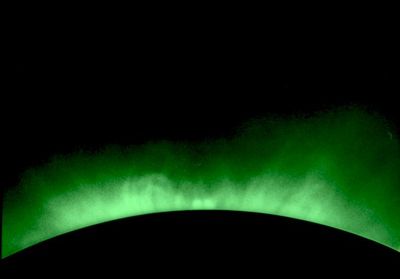


During the 1869 solar eclipse, two astronomers identified an emission line in the spectrum from the Sun’s corona that didn’t match any known substance. Some decided it must be a new element, and it was named coronium, although others favored newtonium. Eventually it became clear no such element exists, and that the emission line at 530.3 nanometers has an even stranger cause, but that didn’t stop coronium exerting an influence on the course of science.
The stage was well set for the announcement of coronium. The fact that each element and molecule has a distinctive spectrum when heated, as unique as a fingerprint, had been discovered 50 years earlier. In 1868, also during an eclipse, several astronomers detected an unknown spectral line that founding Nature editor Joseph Lockyer proposed represented a new element he named helium, after the Greek word for Sun.
When another eclipse occurred the following year, helium had still not been isolated on Earth, so its nature was a mystery. Nevertheless, the prospect of discovering further unknown elements was one of the drivers that caused scientists to travel to places as hard to reach as Alaska to observe the eclipse, and the distinctive green line suggested they had found one.
No sign of it was found on Earth for decades but the color was prominent enough that photographs taken during eclipses showed a tinge of green to the outer corona. Its presence during eclipses was frequent enough that by 1887 the name coronium was widely used, and offered some suggestions on properties.
The year of the eclipse was also the one where Dmitri Mendeleev arranged the known elements into the first periodic table, but plenty of gaps remained. Where the new element fitted was not certain, but there was little reason to doubt it had its place, particularly when helium’s existence was confirmed on Earth.
However, as more and more other elements were found, coronium started to become a problem. Lacking an understanding of atomic composition, Mendeleev proposed coronium had an atomic weight of 0.4. We now know even a single proton weighs more than double this, so no element could be this light.
At the time, however, Mendeleev also proposed ether, the substance that was thought to fill interplanetary space like an atmosphere, weighed even less, proving that even geniuses can be embarrassingly wrong at times. Mendeleev also predicted another 14 elements of plausible atomic weights, eight of which turned out to be remarkably accurate. By 1904 Mendeleev’s greatly improved periodic table still had a spot reserved for coronium at the top of the noble gases column, even though no evidence beyond the spectral line had been found.
Mendeleev also renamed the substance newtonium, which may represent the reason the father of modern science ended up not being honored with an element that stood the test of time.
Alas coronium/newtonium continued to prove elusive as a substance that could be caught and studied, unlike helium whose existence was verified in 1895. In the 1930s two chemists showed the 530.3-nanometer line came from iron atoms ionized to an astonishing 13+. This requires the stripping away of half iron’s 26 electrons, while one of the remaining electrons becomes excited, releasing light at 530.3 nanometers upon returning to its normal energy level. Other unexplained spectral lines seen in the corona were found to be from slightly less ionized iron, or other metals ionized to improbable degrees.
To remove electrons not just from an element’s outer shell, but so much closer to the nucleus, requires temperatures of around a million degrees. Since the surface of the Sun is only 5,700 Kelvin (9,800 °F) this was originally considered deeply implausible. However, we have since learned that the solar corona is indeed hundreds of times hotter than the outer layers of the Sun itself. Almost a century after the evidence for this strange phenomenon emerged, astronomers are still trying to explain it. Indeed, it’s one of the primary objectives of the Parker Solar Probe.
We’ve since found Fe13+ line in the coronae of other stars, proving it’s not just the sun whose atmosphere is anomalously hot.
[H/T: Atlas Obscura]