Nature
 PUBLISHED


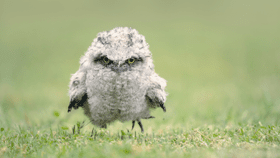


The baby schema effect describes how human babies’ faces have evolved to be perceived as cute, increasing the likelihood of caretaking behaviors by their parents. In the animal kingdom, we see alternative adaptations that aim to increase an infant’s chance of survival, such as the conspicuously colored mouths of baby birds which make prey transfer easier for the adults. So, what inspires the tawny frogmouth (Podargus Strigoides), a rather unusual-looking bird found across Australia’s mainland and Tasmania, to be a good parent? Looking at their offspring, apparently tiny, fluffy pom-poms of pure rage.
You might imagine a frog with wings (such a thing did exist once, sort of) to be quite the comical character, but the tawny frogmouth is a cantankerous predatory bird who, frankly, has had enough. Scowling in the treetops, they can be almost impossible to spot thanks to feathers that blend them seamlessly into tree trunks and branches. Frogmouths sometimes get confused for owls, owing to their appearance (and probably the "tawny" in their name), but they are actually related to nightjars. Their camouflaging skills come in handy as the birds can appear as inanimate objects to passing prey who get scooped up in an instant once in the frogmouth’s range.
Photos such as this demonstrate how successful these carnivorous hunters’ adaptations are in their environment, making frogmouths masters of disguise. Their silvery plumage is streaked with black, brown, and white and is vital to their survival – both in enabling them to hunt on the wing as well as camouflage convincingly enough to fool prey. In 2018, a frogmouth who almost lost their life stuck in a wire fence was given a second chance when a vet was able to perform what was essentially a feather transplant, getting the necessary materials from another frogmouth who unfortunately didn’t make it after being struck by a car.

The babies are another matter altogether, starting life with white downy feathers that later develop into a mixture of gray that closer resembles that of their parents. The low center of gravity and round shape off the offspring gives them a silhouette to challenge even the roundest of round bois. They might have a youthful set of white, fluffy feathers, but they come into this world with the same degree of indifference and rage imprinted of their faces, as the characteristic frog-like mouth makes them look very unimpressed indeed.
The resulting morphology bears a decent resemblance to the birds in Angry Birds, or that of a sentient pom-pom seeking vengeance. The enraged baby frogmouth stays with its parents, who will feed the chick until it’s ready to leave the nest at around four weeks old.