Space and Physics
 PUBLISHED



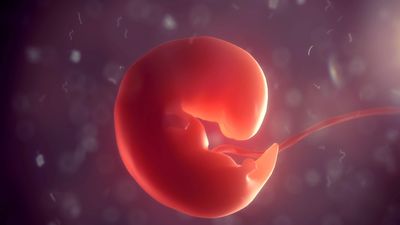


China’s Tiangong Space Station is currently occupied by a group of artificial embryos, marking a major step in the quest to understand the ins and outs of reproduction in space. And while none of the embryo-like structures will ever develop into an actual person, the experiment should at least provide us with new insights into the impact of microgravity on early human development.
Delivered by the Tianzhou-10 cargo craft, the samples are derived from human stem cells and are similar to actual embryos. The plan is to let them grow in space for five days before freezing them and later comparing their development to a control sample on Earth.
While aboard the space station, the artificial embryos are being cultured on either uterine cells or inside a microfluid chip. "We hope that by comparing the development of space and ground samples, we can identify the factors affecting early human embryonic growth in the space environment, and address the risks and challenges humans may face during long-term space habitation," explained project leader Yu Leqian at the Chinese Academy of Sciences Institute of Zoology in a statement.
“This is not a real human embryo and does not have the ability to develop into an individual. However, it can serve as a model for studying early human development," said Yu.
The researchers hope to gain a deeper understanding of the issues affecting human reproduction in space. At present, it’s unclear exactly how microgravity and cosmic radiation might impact our ability to reproduce beyond Earth’s orbit, and until we crack the problem of sex in the cosmos, we’re unlikely to be able to colonize any other planets.
Previous research has shown that human, pig, and mouse sperm become disoriented in microgravity and are therefore less likely to be able to navigate the reproductive tract. A separate study found that jellyfish who spend their youth – or polyp stage – in space tend to experience vertigo when brought back to Earth, struggling to swim in a coherent manner.
On the other hand, mouse sperm that was sent to the ISS has been successfully used to rear healthy pups on Earth, suggesting that exposure to cosmic radiation may not cause harmful levels of DNA damage. Mouse embryos were also seen to develop normally onboard the ISS for a period of four days, eventually becoming blastocysts – collections of cells that later develop into the fetus and placenta.
The current Chinese project represents the first attempt to study human embryonic structures in space, and plenty more research is needed before we’ll be able to say whether or not it’s possible to actually produce cosmic babies. For now, though, Yu says that “the experiment is going very well.”