Humans
 PUBLISHED


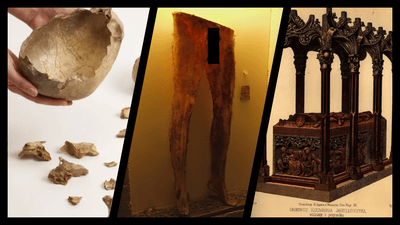


Homo sapiens is a complex species and for all our intelligence, we’ve encountered and created some pretty horrifying scenarios. This year we’ve dived into some of the weirdest “cures” we’ve come up with for history’s deadliest diseases (some of which were worse than the disease itself), as well as curious approaches we've taken to dealing with our dead, including what we can learn from skeletal remains.
Explore some of the weirdest stories from 2023 as we embrace the darker side of science.
The Fungal Resting Places Of Some Of History’s Most Significant Figures May Have Caused A Mysterious String Of Deaths
When Casimir IV Jagiellon, the King of Poland, died in 1492, nobody could’ve predicted the death that would follow the reopening of his tomb half a millennium later. Having rotted away into a biological bomb of pathogen potential, it became a hazardous place for the living to poke around in. Unfortunately, in 1973, that’s exactly what a group of archaeologists did.
According to researchers at Guy's King's and St Thomas' School of Medicine, of the 12 scientists present when the tomb was opened, 10 died within weeks. They also reported that a variety of fungi was cultured from the tomb. Aspergillus was among the samples, a fungi that’s been pinpointed as a possible explanation for the death of Lord Carnarvon soon after opening Tutankhamun’s tomb, spurring rumors of the “mummy’s curse”.
It wouldn’t be the first time harmful pathogens have been found in ancient tombs. In 2018, researchers studying publicly available databases of ancient DNA stumbled across something significant lurking in the Frälsegården passage grave in Sweden that dates back a modest 4,900 years. The strain of the Black Death found there may have been behind the earliest known human pandemic.
Rivers Of Mercury And The Pursuit Of Immortality
There’s a lot of talk about longevity these days, but we should learn from the lessons of China’s first emperor, Qin Shi Huang, who found out the hard way that sometimes the “elixir of life” can actually push you closer to death. Back in Qin Shi Huang’s day, mercury was thought to pass on great power to those who consumed it. We now know that quite the opposite is true as ingesting too much mercury will get you dead.
Mercury now remains one of several reasons why archaeologists are too scared to open Qin Shi Huang’s tomb. Ancient accounts state that many booby traps have been set up to kill any intruders, and large concentrations of mercury detected in the tomb could mean the rumored threat that grave diggers will be flooded with the toxic liquid could be true.
Alternative Funerary Practices
In the same year that New York officially welcomed human composting as a method of disposing of the dead, we learned that cannibalism was a common funerary practice in Europe 15,000 years ago. A 2023 study uncovered Magdalenian remains in England’s Gough’s Cave that consistently showed signs of chew marks, as well as manipulation of bone to create tools.
Another burial mystery came from Shanidar Cave in Iraq, where scientists were curious as to why a Neanderthal grave had been found stuffed full of pollen. The pollen clumps were a mixture of species that were unlikely to be in bloom at the same time, said the researchers, and were more mixed than you would expect had whole flowers been placed into the grave, indicating the pollen arrived via a different vector than humans. Their explanation? Bees.
"Necropants" Made Of Human Skin Were Once Rumored To Make You Rich
Everybody loves a harebrained get-rich-quick scheme, but if there’s one that has to top the “Absolutely Not” charts it’s surely necropants. The pants, also known in legend as nábrækur or nábrók, were rumored to bring the wearer of a pair of human-leg-skin trousers riches, but only if you followed a strict set of instructions…
"Mummy Brown" Paint Used Ground Up Human Remains To Make Art
And while we’re on the topic of weird things to do with the dead, did you know that Eugène Delacroix's Liberty Leading The People may contain people? “Mummy Brown” – made of the ground-up remains of mummified people, and cats – became a firm favorite of European painters back in the 16th century, cherished for its transparency that lent itself to shadows, flesh tones, and glazing, both in oils and watercolors.
Liking The Darker Side Of Science? Join our Facebook group for similar stories, or get some relief with our counter-page, The Lighter Side Of Science.