Culture and Society
 PUBLISHED


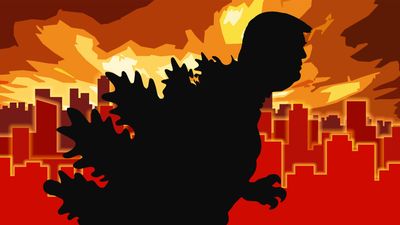


When he comes to town, no one’s safe.
He smashes everything around him, trampling people as he progresses, toppling buildings and crushing bystanders under the falling debris. Even those who are not immediately in his path of destruction find their lives inadvertently changed in the aftermath of his passing.
It doesn’t even matter that he’s not always targeting citizens either, for this being embodies collateral damage and all the insecurity, uncertainty, and potential for destruction that comes with it.
His appearance is always overwhelming; our most trusted institutions turn out to be impotent against such a force. In some cases, these institutions are even responsible for his rise.
Everyday citizens have very few ways to deal with him. You can flee from him, or try to distract or redirect him, but you cannot stop him.
What’s more, there are some who try to capitalize on his presence for their own gain, using the chaos as opportunity while more heroic figures sacrifice themselves in a fruitless effort to save the day.
Ultimately, dealing with this threat requires a reorientation of different groups – scientists, military forces, government officials, and regular people – who develop novel weapons or complex plans to mitigate the devastation.
Godzilla, the iconic Japanese monster or kaiju, has fascinated generations of cinemagoers with his chaos.
His appearance has varied across the decades, with him transitioning from a serious Cold War-inspired hazard in the 1950s to a reluctant, but nevertheless camp, comical hero in increasingly silly plots a decade or so later.
But the legendary dinosaur-like creature has also served as a powerful metaphor – the King of Metaphors, if you will – for various real-world colossal threats. In his earliest forms, he was a symbol of the atomic weapons dropped on Japan in August 1945, then a kind of environmental protector, and then more recently a force of nature akin to climate change.
Godzilla, like many monsters, is flexible enough to represent many things, even people. Since he was first elected in 2016, various political commentators have compared President Donald Trump to the rampaging beast.
In September that year, a contributor to the Huffington Post wrote that giving equal time to criticizing the then presidential candidate and his opponent, Hilary Clinton, was unhelpful.
So to say Trump is Godzilla is not just to say that Trump does things, but that he will do things over time in the way that Godzilla does.
Professor Robert Boatright
“This has created a false equivalence,” they wrote. “Imagine a political contest between Godzilla (Trump) and Bambi (Clinton). Because of the equal time rule, the nightly news would report, ‘Godzilla destroys Los Angeles,’ and then, ‘Bambi ravishes community garden’.”
A year later, the comedian Trevor Noah commented that “Trump is a problem solver the same way Godzilla is a city planner,” while discussing a speech the president made about his Afghanistan strategy. “The only way Donald Trump could consider himself a problem-solver is if he stops creating problems,” Noah added.
Similarly, during his interregnum in 2021, an article in Politico referred to Trump as a “Godzilla in exile”.
As Professor Robert Boatright, a political scientist at Clark University, recently explained in a new paper, a casual Google of “Donald Trump Godzilla” will return around a million hits, offering cartoons, GIFs, editorials, news stories, and even merchandise related to the president in giant lizard form.
The metaphor potential is strong and clearly has been exploited for its representational power.
"A single state comparison"
These metaphors are cognitive tools that offer culturally specific ways of understanding the world through a representation. In this sense, comparing Donald Trump to Godzilla makes understanding his behavior more accessible by mapping it onto a familiar form.
But there are limits to just how useful metaphors are. At the end of the day, a representation can mislead us into thinking we know how things will turn out based on the thing doing the representing (e.g. Godzilla in his own narrative trajectory).
But can the beast’s monstrous hide be used for a more meaningful comparison that goes beyond a metaphor?
Professor Boatright thinks so. In his recent paper, he explains how Godzilla can actually offer us an allegory for Trump’s story and behavior.
“The problem with using this metaphor for Trump is that metaphors are what you would call a single state comparison,” Boatright told IFLScience.
For instance, if someone says “the heart is a lonely hunter”, you know that it’s saying the heart – the inner feelings or deep desires – is in the state of being of searching for connection/love alone. It is a direct equation of two things – heart and hunter – as one specific moment and experiencing one condition: loneliness.
In some ways it was a fun exercise, but I think there's a serious point to what I'm trying to do here.
Professor Robert Boatright
“But the problem with using the Godzilla metaphor is that Godzilla goes and does things, right? People's acquaintance with Godzilla has to do with whenever or whichever of the Godzilla films they've watched [as well as] all the things that Godzilla does.”
“So to say Trump is Godzilla is not just to say that Trump does things, but that he will do things over time in the way that Godzilla does.”
This mode of comparison is allegorical; it’s a way of using stories, characters, settings, or events to express hidden or bigger ideas. By viewing Godzilla as an allegory for President Trump, a crude comparison becomes a potentially useful prism for seeing otherwise obscured but nevertheless meaningful insights.
And this is an important point. It may sound silly to use a fictitious monster to understand a real-world political figure, but it actually taps into something political scientists do more generally.
“Political science in many ways is involved in predicting what will happen based on the dynamics of past events,” Boatright explained.
In this context, researchers may look at historical events or people as a way to interpret current affairs.
Many people are likely used to seeing commentators reflect on historical figures such as Napoleon or Caesar as comparative models. Alternatively, they may turn to the careers of past presidents like Andrew Jackson or Richard Nixon, the populist politician William Jennings Bryan, or the controversial Senator Joseph McCarthy.
Some of the narratives related to these figures may be more useful than others, indicating converging or diverging trends.
The same exercise can be performed with fictional characters too. For instance, you could ask what the narrative trajectory for Richard Nixon was and what happened to Shakespeare's Macbeth or Richard III. Such a process can reveal patterns that may not be visible without such comparisons.
At the same time, fictional characters are sometimes more accessible than historical ones. For instance, if you want an allegorical assessment of Trump, how many people will be familiar with Bryan’s story compared to that of, for example, Darth Vader?
“If you think about Star Wars,” Boatright explained, “pretty much everybody understands the trajectory of the story. And it would be a little bit less unusual, perhaps, to compare Trump to, say, Darth Vader or somebody like that, right? Everybody would get that.”
“And so my argument in [the paper] is even though not everybody has watched all of the Godzilla movies, everybody understands the sort of things that Godzilla does.”
By putting Trump in this framework, Boatright contends, it becomes possible to understand what he does while also potentially allowing politicians to know how to react to him.
“In some ways it was a fun exercise, but I think there's a serious point to what I'm trying to do here.”
Trumpzilla vs. monsters
During his research, Boatright examined the Showa period Godzilla films, which appeared between 1954 and 1975. These films, he argues, can be read as an allegory for Trump’s political career from 2016 to 2021.
Through this, he shows that Trump parallels appear in the development of the Godzilla films that are not present in a simple metaphorical comparison.
Secondly, and arguably more significantly, he shows that throughout the films, Godzilla is not the only major character – in most films, the giant monster is caught in conflict with another monster. These additional creatures, Boatright argues, can be representatives of individuals associated with Trump and his presidency.
This latter point is where the fun and the informative converge: Godzilla metaphors for Trump are common, but allegorical comparisons that include others are much rarer.
This is not to say that others have not tried to liken Trump’s political conflicts to those captured on the silver screen. His clash with Senator Mitch McConnell in 2021 was referred to as a battle between Godzilla and King Kong – but ultimately, how does McConnell resemble the enormous ape? This comparison is superficial and tells us very little.
In contrast, Boatright identifies other conflicts that are more analytically useful. For instance, the film Mothra vs. Godzilla (1964) can be interpreted as a parable for Representative Liz Cheney and the House Select Committee during their investigation into the January 6 insurrection.
I think there’s a danger when you think about your politicians as being these larger-than-life-figures; it downplays the role we play in a democracy.
Professor Robert Boatright
In this sense, Cheney can be likened to the giant moth kaiju Mothra, a protective entity overlooking a remote island.
In this movie, Japan calls on the creature to help fight Godzilla. Mothras don’t live long after laying eggs – which she has already done as one of her eggs plays an important role in the narrative – so her fight against Godzilla can be seen as a sacrifice to achieve a common good.
Cheney is also a Republican, but one representing the party’s more traditional political values. Her decision to support Trump’s impeachment effectively ended her career, which appears similar to the sacrifice made by the giant moth.
There’s also Godzilla vs. Mechagodzilla (1974), featuring a confrontation between the titular protagonist and a human-made robotic alternative. This mechanical Godzilla was created by an alien race – the Black Hole Planet 3 Aliens – to mimic Godzilla’s abilities and with he aim of surpassing him.
“[Mechagodzilla] is stronger than Godzilla. It is in some ways, engineered not to have the various flaws that Godzilla has, but it doesn't really respond to things sort of intuitively the way Godzilla does,” Boatright added.
The parallel here, he contends, is the rise of Ron DeSantis, the governor of Florida, who was once seen as the strongest Republican candidate to replace Trump after he left office in January 2021. At this point, it wasn’t clear he would run again, so Republicans sought an alternative, enhanced Trump-like figure to replace him.
As Boatright notes in his paper, an opinion piece published in the New York Times even described DeSantis as “a more competent Trump” who was better at using “the levers of state to amass power”.
DeSantis was their Mechagodzilla, and he went the same way as his mechanical counterpart.
“He tried to use Trump's rhetoric. He tried to use some of the appeals that Trump had. And ultimately, his campaign was a disaster,” Boatright said. “He didn't have the sort of connection with voters that Trump had, nor did he have the sort of sympathy that Trump got from a lot of people who didn't take him totally seriously.”
Even the New York Times article noted that while DeSantis was “meaner and more rigid” than Trump, he lacked the “soft edges and eccentricity” of the figure himself.
“Another common theme in the films is that Godzilla never dies,” Boatright said. “At the end of every film, [he] kind of goes away.”
“For a while in the late 1960s films, there was an island on which various kaiju were effectively impression – Monster Island. There are clear parallels here to Mar-a-Lago. During Trump’s period out of office, he was kind of contained. But the movies show that this is unstable.”
Sending Trump or Godzilla into exile is, he contends, “ultimately doomed to fail. They always come back.”
Of course, these themes are not unique to Trump per se. You can say similar for historical figures like Napoleon or even Winston Churchill, but the allegory works well for the current president in this instance.
Finally, there’s one more group in these movies that need to be considered for their allegorical value: us.
“Humans are spectators in the Godzilla films,” Boatright notes. “They don’t play any real role. And I think there’s a danger when you think about your politicians as being these larger-than-life-figures; it downplays the role we play in a democracy. It can also be easy to look as these things and to say, ‘well, [to survive] we need to find a monster that we like’.”
“I think one of the complications of the entire Godzilla franchise is that people don't really get together to do much of anything in any of the films. And I wouldn't want people to assume [...] that our politics is really just a battle of monsters.”
Like history, the Godzilla films can offer us valuable allegories for understanding the people or events that we witness. However, we shouldn’t mistake these narratives for concrete predictions, otherwise we become just more tiny people waiting for the kaiju to step on us.