Nature
 PUBLISHED


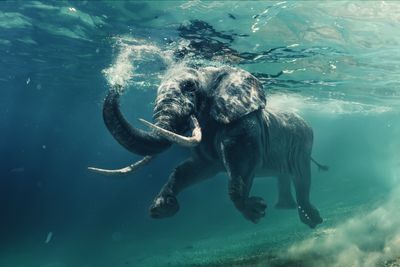


Elephants might not look like hydrodynamic, athletic swimmers – but then again, neither do whales, walruses, or other blubbery mammals that take to the sea. Despite their massive frames, the ability to navigate water is hardwired into their DNA and remains an important part of their evolutionary history.
Both African elephants and Asian elephants are known to be strong swimmers, with many instances of individuals and groups taking to the waters to island hop. They’re also known to frolic in shallower waters to cool off, care for their skin, or just play.
Their buoyancy is aided by their massive lung capacity and the fatty tissue in their bodies, allowing them to float more easily than one might expect. Their lengthy trunk is also a useful tool that can become a snorkel-like breathing tube when the waters get deep and choppy.
How far can elephants swim?
The distance an elephant can cover in the water is pretty staggering. A study in the Journal of Biogeography cites an account from 1856 in which an African elephant was forced to swim for 48 kilometers (nearly 30 miles) into the Atlantic Ocean, presumably as part of a deeply unethical experiment.
In 2016, a more reliable account explains how an Asian elephant was found swimming 16 kilometers (almost 10 miles) off the coast in the Indian Ocean. The lost elephant, clearly in trouble, had to be rescued by the Sri Lankan Navy after it was swept away by a current, barely keeping its head above water and using its trunk like a snorkel to breathe. Fortunately, it managed to survive the ordeal.
Rajan: The famous Asian elephant
Perhaps the most famous ocean-swimming elephant was an old bull known as Rajan. Along with nine other elephants, he was brought over to the Andaman Islands in the 1970s to haul logs. When logging was outlawed in 2002, the working elephants were forced out of their jobs. This early retirement was welcomed by Rajan, who reportedly developed a morning ritual of strolling down the beach to have a leisurely swim in the sea each day.
Sea-faring elephants are not solely a product of modern, human-driven circumstances. Across the world, fossils of elephants and their close ancestors have been found on fossils, from islands off the coast of California, in parts of Southeast Asia, and in the Mediterranean.
It’s reasonable to assume they didn’t all arrive on the islands because of rogue currents, nor did they wander over on foot when water levels were low.
Multiple studies suggest that modern elephants evolved from semi-aquatic ancestors, extinct animals that perhaps looked a bit like a proto-hippopotamus. By studying the chemical composition of ancient elephant teeth, scientists have been able to show that they spent their days in water, eating freshwater plants. This suggests they share a common ancestry with the sirenians, the order of fully aquatic mammals that includes dugongs and sea cows.
While it would be a stretch to put elephants in the class of semi-aquatic mammals, swimming is a well-established part of their nature.