Nature
 PUBLISHED


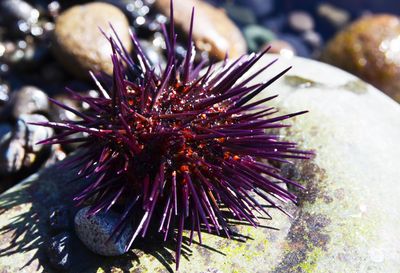


Sea urchins look like an inanimate bundle of needles, but a closer look at these alien-like creatures reveals a surprisingly complex “all-body brain” that challenges our assumptions about nervous systems, evolution, and the nature of intelligence.
Echinoderms – the phylum of animals that includes starfish, sea cucumbers, sea urchins, and others – are easy to dismiss as “simple” creatures. They might look pretty, but they lack many of the features we typically associate with charismatic creatures and complex intelligence, primarily a centralized brain.
It was previously held that all echinoderms possessed only a rudimentary radial nervous system, little more than an interconnected nerve net with no central processing hub. However, new research suggests that these creatures are more neurologically complex than once thought.
In a recent study, researchers used single-cell and gene-expression analyses to map every cell in the purple sea urchin (Paracentrotus lividus) shortly after it underwent metamorphosis from its embryonic stage to its adult form.
Their findings revealed an unexpectedly diverse array of neuronal cell types, with hundreds of the neurons analyzed found to express both "head"-related genes specific to echinoderms and those seen in vertebrate central nervous systems, too. Instead of a basic decentralized nerve net, these animals were found to have an integrated, brain-like system that extends throughout the entire body.
The researchers also discovered light-sensitive cells distributed across the sea urchin’s surface. These cells are structurally similar to those found in the human retina, but instead of being concentrated in a single organ like the eyes, they are scattered across the body.
Based on their findings, the researchers argue that sea urchins shouldn’t be thought of as “brainless” at all. Instead, they propose that these creatures possess an “all-brain” organization. In other words, rather than having a centralized nervous system and distinct sensory organs, their neural hardware is diffused throughout the entire body.
“Our results show that animals without a conventional central nervous system can still develop a brain-like organization,” Dr. Jack Ullrich-Lüter, one of the study’s first authors at the Museum für Naturkunde Berlin, said in a statement.
“This fundamentally changes how we think about the evolution of complex nervous systems,” he added.
Humans have a bad habit of only recognizing intelligence in creatures that have nervous systems that look like our own. We readily accept that chimpanzees and dolphins are smart, but our confidence can waver as intelligent life grows less familiar, like in the problem-solving corvids, the shape-shifting cephalopods, or even the eerily coordinated slime molds.
The octopus is a perfect example of this. With a doughnut-shaped brain encircling its esophagus and a complex network of “mini-brains” extending through its arms, it could easily be misconstrued as a simple invertebrate, yet we now know that octopuses are vibrantly intelligent and sentient creatures.
Perhaps, therefore, we should reconsider the sea urchin. Far from being an unfeeling, uncharismatic sea-thing, echinoderms may be more akin to a strange, alien intelligence that we are yet to fully understand.
The study is published in the journal Scientific Reports.



 1
1