Space and Physics
 PUBLISHED



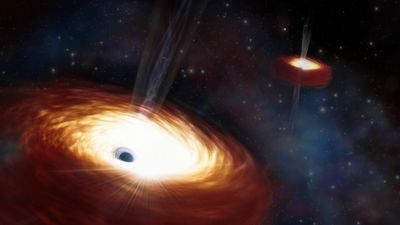


When galaxies collide, the supermassive black holes at their center can move close together, begin orbing one another, and eventually merge. Such a merger has never been seen but binary supermassive black holes have been known to exist at the core of several galaxies. And astronomers have now crowned the heaviest pair yet.
These two objects sit at the center of elliptical galaxy B2 0402+379. Thanks to archival data from Gemini North's Gemini Multi-Object Spectrograph (GMOS), researchers were able to resolve the two objects separately – the first time this has been possible. This led to another first, they estimated that the two objects are just 24 light-years apart. Closer than the star Vega is to Earth.
But these are not stellar objects we are talking about. The black holes weigh 28 billion times the mass of the Sun, plus or minus 8 billion solar masses. Crucial to this estimate is the ability of astronomers to measure the motions of the stars at the core of this elliptical galaxy.
"The excellent sensitivity of GMOS allowed us to map the stars' increasing velocities as one looks closer to the galaxy's center," Roger Romani, Stanford University physics professor and co-author of the paper, said in a statement. "With that, we were able to infer the total mass of the black holes residing there."
Binary black holes tend to merge over time (as gravitational waves observations have shown) but researchers worked out that this pair has been stuck at that distance for 3 billion years. They are unlikely to merge any time soon – and their extreme mass might be the reason why.
For objects such as this to merge, they need to lose orbital energy. Neutron star binaries or black hole binaries can do that by releasing gravitational energy as they go around each other. For these gargantuan objects that is not enough. Gas and stars orbiting around them can give them a little push by stealing some of this energy away.
But it seems that this massive galaxy has run out of gas and stars at the center. Without it, the supermassive black holes are in a stable orbit around each other, and this also allowed astronomers to observe these two objects.
"Normally it seems that galaxies with lighter black hole pairs have enough stars and mass to drive the two together quickly," added Romani. "Since this pair is so heavy it required lots of stars and gas to get the job done. But the binary has scoured the central galaxy of such matter, leaving it stalled and accessible for our study."
If they do merge, the gravitational waves released would be a hundred million times more energetic than what we have detected so far. But the team is skeptical that that is going to happen. Another merger is unlikely to take place in the future, but maybe there’s enough gas to eventually get them merging.
“We’re looking forward to follow-up investigations of B2 0402+379’s core where we’ll look at how much gas is present,” added lead author Tirth Surti, an undergraduate researcher at Stanford. “This should give us more insight into whether the supermassive black holes can eventually merge or if they will stay stranded as a binary.”
The possibility, or maybe impossibility, of a binary supermassive black hole merger has been a topic of debate among astronomers for decades. It is known as the final parsec problem.
The paper is published in The Astrophysical Journal.