Nature
 PUBLISHED
 1
1


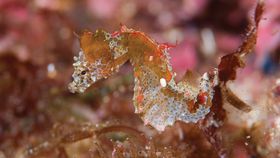


We’re starting off the week on an incredibly positive note with the announcement of a new species of pygmy seahorse discovered off the coast of Japan – and the best thing? They’re not rare, endangered, or threatened in any way.
Meet Hippocampus japapigu, or the “Japan pig”, which may not sound dignified, but was what the local divers who first spotted them in south-eastern Japan nicknamed them.
“[T]o the locals, it resembles a tiny baby pig,” Graham Short, lead author of the study officially describing them in ZooKeys, told National Geographic.
Since they are so tiny – an adult only grows to the size of a grain of rice – and their colors are not just beautiful, but perfect for camouflaging the tiny creatures as bits of floating seaweed or algae, it’s not hard to see why they went officially undetected for so long.

Though they had been known to divers diving in the shallows off Hachijo-Jima Island, of the Izu Islands in Japan, Short and his colleagues realized the little sea equines were actually unique to the six other known species of pygmy seahorse – not that you’d be able to tell with the naked eye, though.
They had been thought to be a variant of the Pontohi’s seahorse, but once they were able to study them in detail the researchers realized the exquisite color and detailed pattern of the creatures meant they were something entirely new.
“It's like a seahorse wearing a paisley pattern,” co-author Kevin Conway of Texas A&M University, told NatGeo.

When they took CT scans of them they realized there were other differences. They have an odd ridge of bone on the upper back, which may have evolved due to sexual selection, but it’s not really clear. Like other pygmy seahorses, they have a wing-like structure on their back, again to what purpose it’s unknown, however unlike the others, instead of two pairs, H. japapigu has just one.
They also live in quite an unusual habitat for seahorses. The shallow waters of Hachijo-Jima Island fluctuate in temperature depending on the season, something most seahorses don’t like. The fact they were found at only 10-11 meters (33-36 feet), when most pygmy seahorses prefer much deeper water, is also unusual.
This is where being so small comes in handy. Some species of seahorse can grow up to 35 centimeters (14 inches), but the Japan pig measures around 16 millimeters – small enough “to fit two or three on the nail of my pinkie,” according to Short.
However, being tiny means pygmy seahorses can evade detection by both predators and humans, especially those who seek to use them in “traditional” Chinese medicine or for the highly lucrative aquarium trade.
“But this will never be an issue for pygmy seahorses, because they are just too hard to find,” Short said.