Nature
 PUBLISHED
 1
1


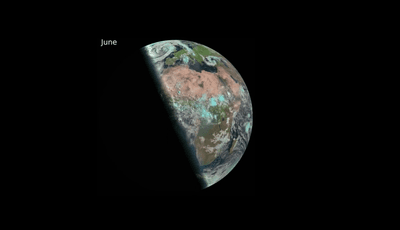


If you've ever heard that Earth’s tilt influences the number of daylight hours we receive throughout the year, but never really understood how, then this beautifully made animation is for you.
It was created by Simon Proud, an Earth-observation scientist at the UK’s National Center for Earth Observation, in celebration of the summer solstice in the Northern Hemisphere on June 21.
In a tweet about his creation, Proud explains that the images were sourced from weather satellite data from the European Organisation for the Exploitation of Meteorological Satellites. The video was produced by stitching together 365 images, all taken at 6 am on each day over the past year.
You’ll see how in June, when it’s summer in the Northern Hemisphere, places like Europe and North Africa are perfectly illuminated by the sun at 6 am. However, spin forward to December, and it's shrouded in darkness at this time of the morning.
Earth’s tilt is a quirky characteristic of our planet. Its axis is currently tilted 23.4 degrees away from the poles, according to NASA. The tilt is known to change, however. Over the last million years, it has varied between 22.1 and 24.5 degrees with respect to Earth’s orbital plane.
A colossal cosmic collision was most likely responsible for the tilt. It’s hypothesized that Earth crashed into a Mars-sized planet, nicknamed Theia, approximately 4.5 billion years ago in the early days of the Solar System. Along with knocking Earth off its axis, it chipped off a massive piece of rock which eventually become the Moon.
So, next time you're bummed out about the lack of daylight in the depths of winter, you can blame Theia.