Space and Physics
 PUBLISHED


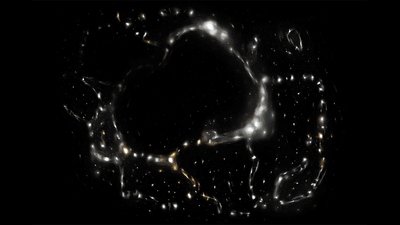


In 1981, while conducting a redshift survey of the distribution of galaxies, astronomers spotted something (or nothing) that they weren't expecting.
"[W]e discovered that the redshift distributions in each of the three northern fields showed an identical 6,000 [kilometers per second] gap. Because these fields were separated by angles of ~35°, this suggested the existence of a large void in the galaxy distribution of at least comparable angular diameter," the team wrote in a paper in 1986, adding, "The low density of this region is of high statistical significance and does not appear easily reconcilable with any of the popular models for the growth structure in the universe."
Lying in the vicinity of the Boötes constellation, it became known as the Boötes Void, or sometimes the Great Nothing. For a long time, it was the largest known void in the universe, spanning 330 million light-years across. To put that in context, that's about 0.35 percent of the diameter of the entire observable universe.
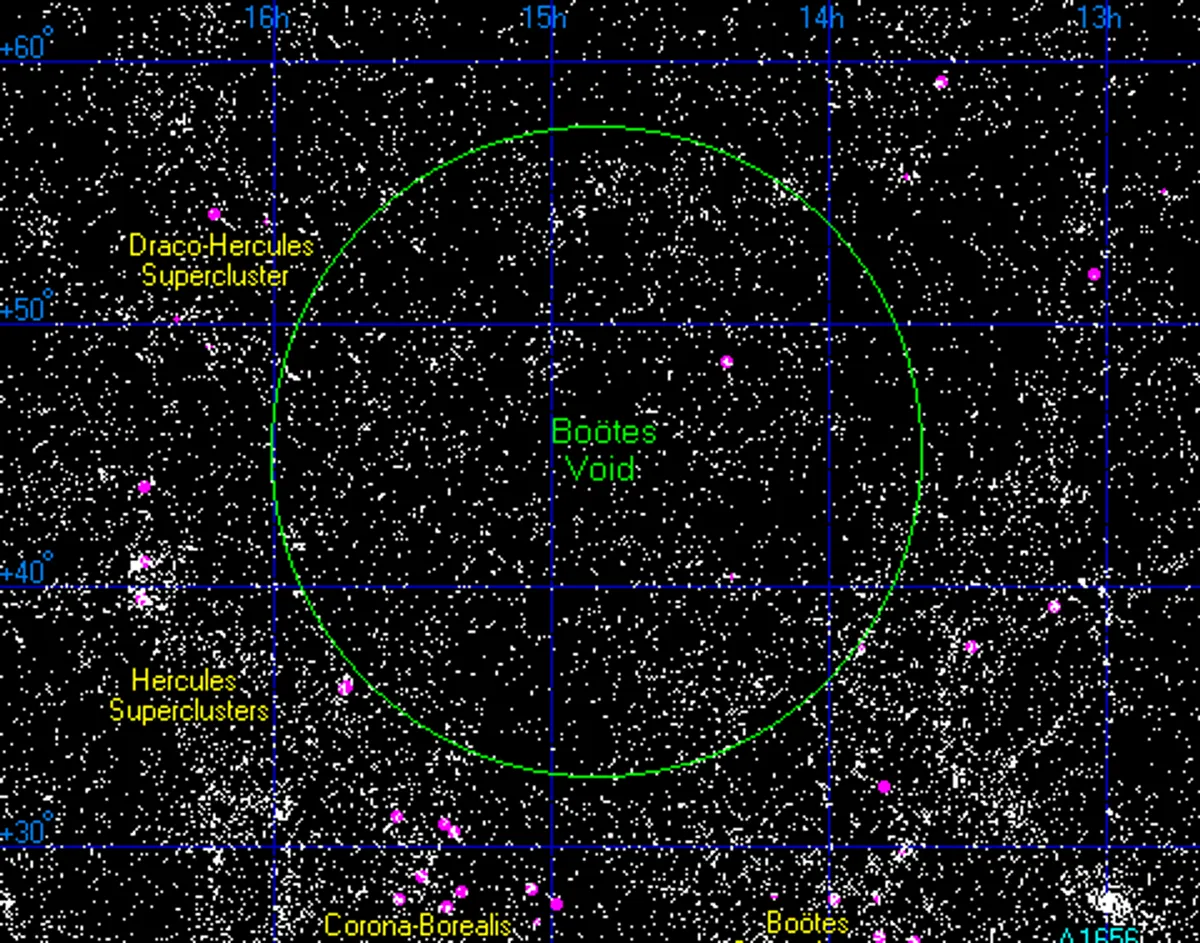
While it is fair to describe it as a void, there are galaxies within it, just a lot fewer than we would expect.
"If we are to use a rough estimate of about one galaxy every 10 million light-years (four times farther than Andromeda)," NASA explains, "there should be approximately 2,000 galaxies in the Boötes Void."
In fact, we've found 60. While there is little about the void to suggest our ideas about galaxy formation are incorrect – one explanation is that it formed from smaller voids merging – it is still an odd thought experiment to picture how someone inside the void must see the universe.
As astronomer Greg Aldering put it: "If the Milky Way had been in the center of the Boötes void, we wouldn’t have known there were other galaxies until the 1960s.”
That was the largest void that we know of. But in 2015, a team found evidence of a much larger void, measuring a whopping 1.8 billion light-years across. The team were looking in the direction of the infamous cold spot of the cosmic microwave background radiation, believing that the cold spot could correspond to a massive void.
Sure enough, they found evidence of a void spanning 1.91 percent of the diameter of observable universe, although the void is still not large enough to explain the mysterious CMB cold spot. For that, we may have to look for other explanations.