Space and Physics
 PUBLISHED
 1
1



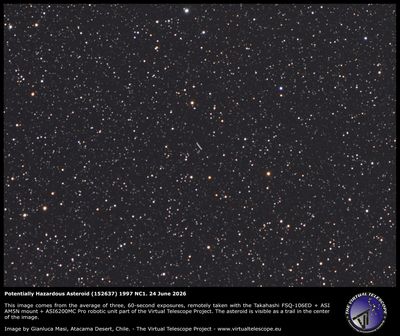


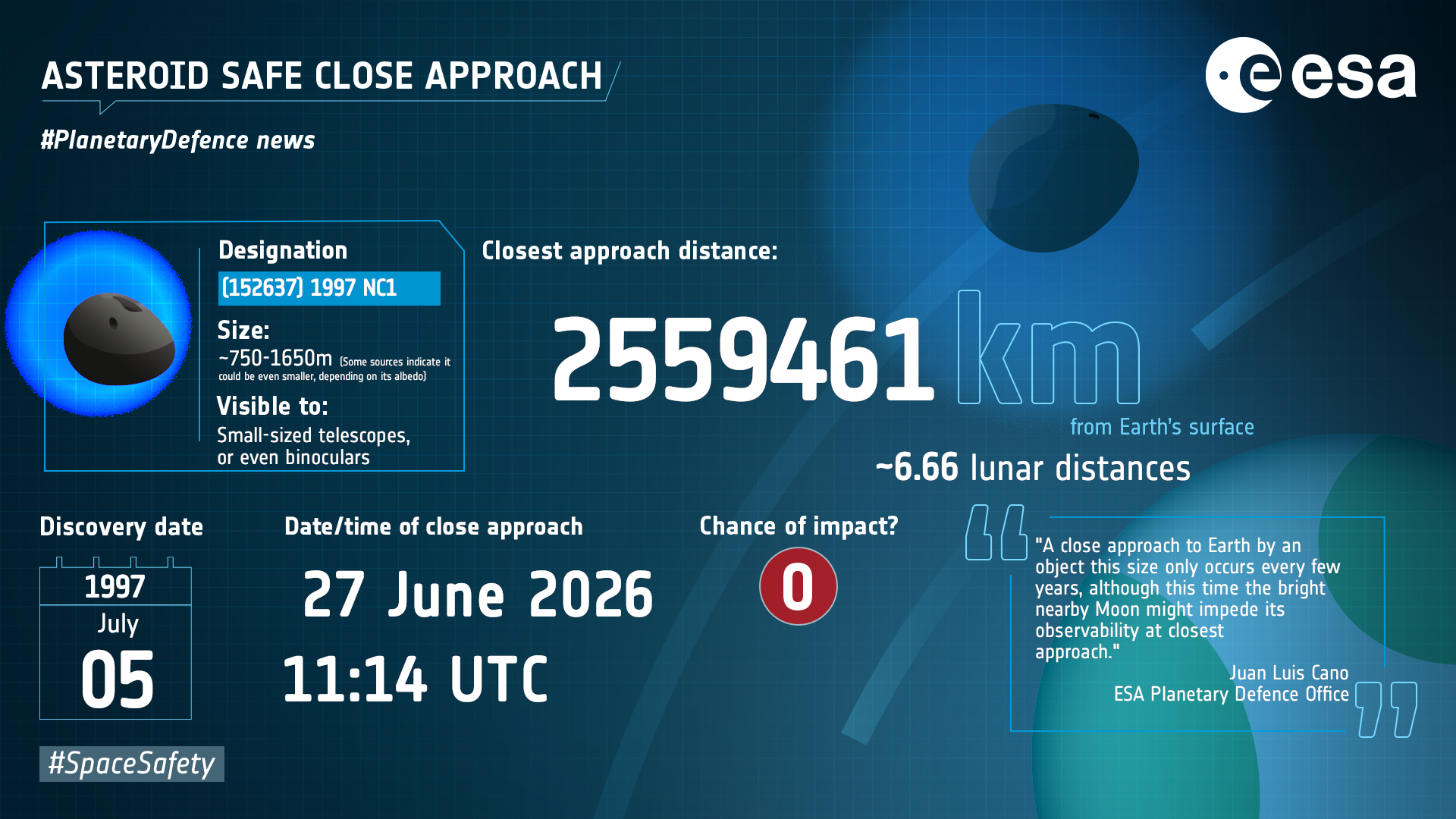
On Saturday June 27, potentially hazardous asteroid 152637 (1997 NC1) will make its closest approach to Earth.
The approach will be its closest in over 400 years, and it won’t be beaten until 2133. It only happens once every few years that a sizable chunk of space rock as big as asteroid 1997 NC1 gets so close to our planet.
The celestial body will pass at the extremely safe distance of about 2,560,000 kilometers (1,594,000 miles) from the Earth’s surface. That’s about 6.66 times the average Earth-Moon distance. The asteroid does not pose any risk to Earth, and will definitely not hit us.
What’s exciting about this close passage, though, is that it could be visible with binoculars or small telescopes. Its closest approach will take place on June 27 at 11:14 am UTC, but for those experiencing night at that time they might have to contend with the bright, almost-full Moon. People in the northern hemisphere will best see the asteroid approaching Earth, while those in the south will better spot it whizzing away.
“A close approach to Earth by an object of this size only occurs every few years, although this time the bright nearby Moon might impede its observability at closest approach,” Jan Luis Cano, of ESA Planetary Defence Office, said in a statement to AFP.
If you are unable to see it for yourself, the Virtual Telescope Project is planning on live-streaming observations on June 26 and 27, both beginning at 11:00pm UTC.
The asteroid is estimated to be between 750 and 1,650 meters (2,460 to 5,410 feet) wide, assuming that the asteroid albedo, or how much light it reflects, is in the range of 5 to 25 percent. Claims that it might have a higher albedo of up to 60 percent would make it much smaller.
"Visible light from the sun reflects off the surface of the rocks,” NASA explains. “The more reflective, or shiny, the object is (a feature called albedo), the more light it will reflect. Darker objects reflect little sunlight, so to a telescope from millions of miles away, a large dark asteroid can appear the same as a small, light one."
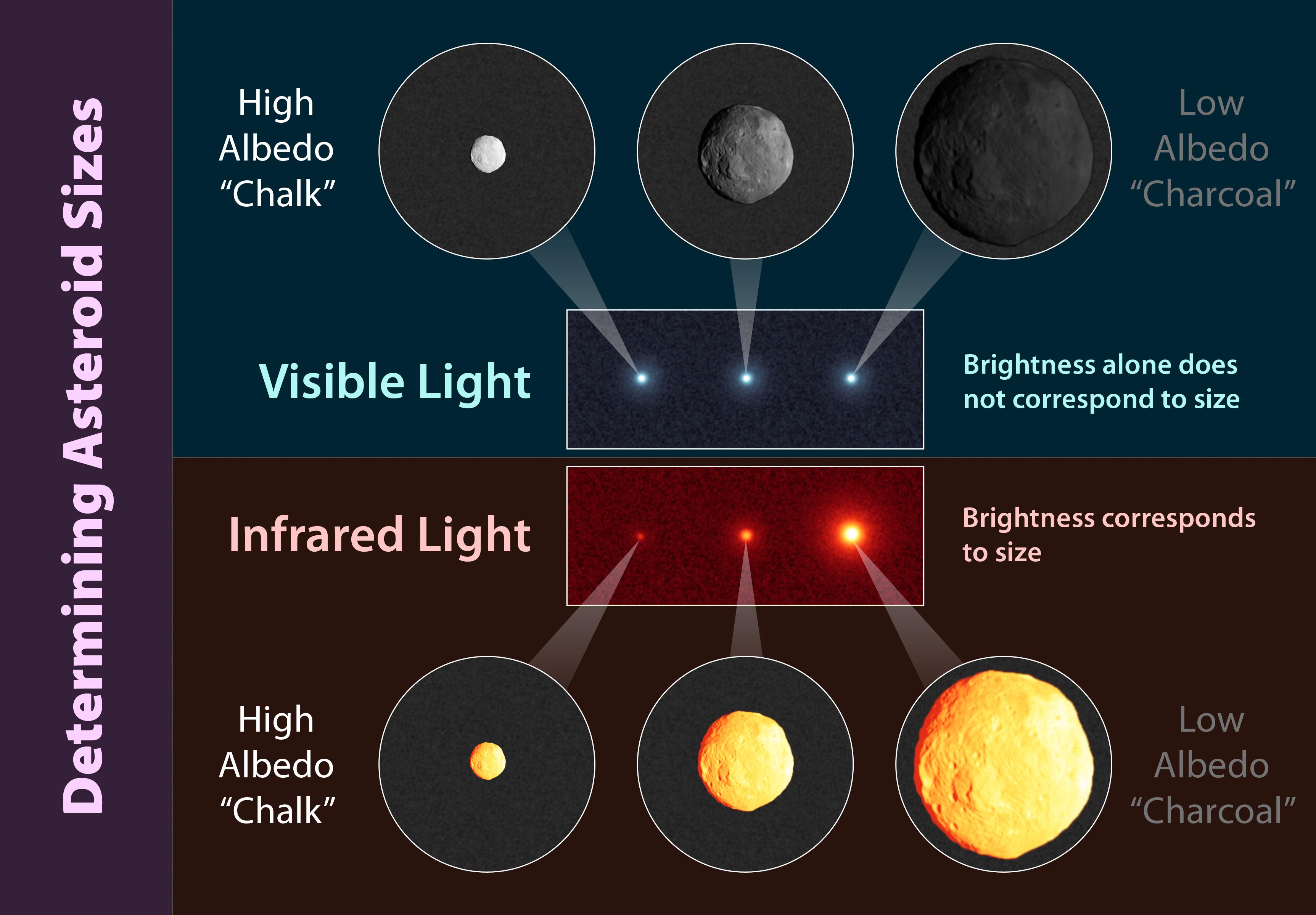
This historically close approach is a great opportunity to better estimate the size of asteroid 1997 NC1. The space agency will employ the Goldstone Solar System Radar (GSSR) as radar is not just used to track airplanes, but also be used to study celestial bodies.
“We plan to use radar observations to help resolve the discrepancies regarding the diameter, spectral class, and optical albedo,” NASA explained.
It is critically important to keep an accurate census of the nearby and potentially dangerous asteroids. Understanding individual objects and asteroids as a whole is key for planetary defense.
"The 2026 flyby distance is unusually close for an object this large," NASA added. "The last encounter closer than this by an object with a brighter absolute magnitude (and presumably a larger diameter) was in January 2022 by 1994 PC1 (H = 16.6), which approached within 5.2 lunar distances (0.0133 au)."
In a few years another asteroid will pass by much closer. Asteroid Apophis is much smaller , but it will provide an exciting opportunity, rather than a concern, and the RAMSES mission will jump on it very soon.
Space agencies around the world keep an eye on the large objects that could cause devastation on a vast scale. The tracking of objects larger than one kilometer in diameter is nearly complete, while we might be missing about half of all those objects larger than 350 meters (1,148 feet).