


 Humans
 PUBLISHED

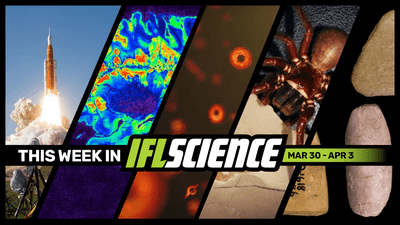


This week, a new breakthrough in multiple sclerosis research has shown some brain cells are killed by uncontrollable DNA damage, a peculiar gravitational wave collision might be the first evidence of primordial black holes, and Native American dice show a conceptual leap that took Europe thousands of years to recreate. Finally, We asked Prof. C Thi Nguyen, author of The Score: How To Stop Playing Someone Else's Game, why is modern life so exhausting?
Create an IFLScience account to get all the biggest science news delivered straight to your inbox every Wednesday and Saturday.
Artemis II Successfully Blasts Off To Take Humans Further From Earth Than Ever Before
Artemis II and its crew of four astronauts have made it to high Earth orbit, marking the first stage of their journey to the Moon and the first time humans have been enroute to our planet’s satellite in 54 years. Read the full story here
New Breakthrough In Multiple Sclerosis Science Reveals Some Brain Cells Are Killed By Uncontrollable DNA Damage
A new discovery is bringing light to a neglected corner of multiple sclerosis (MS) research by revealing how the disease damages the gray matter of the brain. With most historical research focusing on the brain’s white matter instead, study author Steve Fancy believes the new findings could help scientists “begin fighting MS on an entirely new front.” Read the full story here
Peculiar Gravitational Wave Collision Might Be First Evidence Of Primordial Black Holes
In November, a gravitational wave signal was captured by LIGO, and it made researchers very excited: a collision between two dense objects that appeared to be a lot smaller than anything we have ever seen collide and a lot smaller than the predicted minimum mass for stellar black holes or neutron stars. Two researchers have now put forward a radical idea as to what it might be: a primordial black hole. Read the full story here
500-Million-Year-Old Sea Predator Is Oldest Known Animal Of Its Kind – An Ancestor Of Spiders With Surprise Claws
When inspecting a Cambrian-era arthropod fossil, Research Scientist Rudy Lerosey-Aubril at Harvard University noticed something strange. The creature in his hands had a claw where there was supposed to be an antenna. Read the full story here
“It’s Something Even The Gods Are Subject To”: Native American Dice Show A Conceptual Leap That Took Europe Thousands Of Years To Recreate
Ask historians of math when probability was invented, and you’ll likely get a surprisingly specific answer: 1654. That was the year Pierre de Fermat and Blaise Pascal started writing to each other about an unfinished dice game – some legends say it was their own; others that it was a gambler friend of Pascal’s – trying to work out how best to divide the pot. Read the full story here
TWIS is published weekly on our Linkedin page, join us there for even more content.
Feature of the week:
Why Is Modern Life So Exhausting? The Joy Of Games Vs The Misery Of Metrics
Most of us aren’t getting chased by bears and hunting for our food, yet modern life still tires us out. For many people, a favorite way of winding down is playing games, but it makes you wonder – why is keeping score so fun in our free time and so soul-sucking in real life? It’s a question Professor C Thi Nguyen, a philosophy professor at the University of Utah and author of The Score: How To Stop Playing Someone Else's Game, has thought about a lot, so we asked him all about it. Read the full story here
More content:
Have you seen our e-magazine, CURIOUS? Issue 45, April 2026, is available now. This month, we asked, “How Do We Know That The Earth Has A Tilt?” – check it out for exclusive interviews, book excerpts, long reads, and more.
PLUS, the We Have Questions podcast – an audio version of our coveted CURIOUS e-magazine column – continues. In episode 19, we ask, “Which Animals Have The Worst Table Manners?”
Our Break It Down podcast now has a new monthly format, coming at you in both audio and visual. So tune in each month to hear about some of the wildest science stories and adventures we’ve been on. Kick off this month with “AI Assassins, Inside A De-Extinction Lab, And Life On Mars?”
The Big Questions podcast season 5 has now concluded, but here’s one more bonus episode to help see you through to the next: Can Magic Be Used As A Tool In Science? You can catch up on the whole of season 5 here.

 1
1