Space and Physics
 PUBLISHED
 2
2


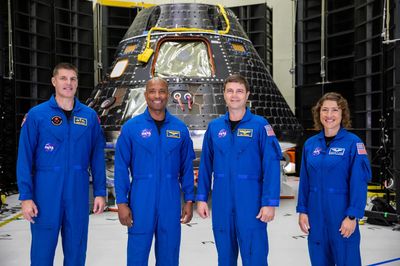


It seems every generation of space explorers must contend with angry conspiracy theorists, as the Artemis II astronauts recently discovered when they were accused of “lying” by a disgruntled man. But while the nature of the conspiracy theories may not have changed much over the years, the astronauts' handling certainly has – unlike one of their predecessors, they didn’t punch the antagonist. That’s progress.
During a recent public event on Capitol Hill, the four Artemis II astronauts were confronted by a man who accused them of “lying”, stating that “You all never went to space”. He recorded his accusations on his phone, where we can see him following the astronauts as they calmly walk away from him. The man follows for a few steps, telling them to “follow Jesus”, that “God’s watching you all,” and that their “psyop isn’t working on millions of us; NASA’s a joke”.
But rather than get upset, argue back, or retaliate, the four astronauts simply ignored the man and walked away. Internet commentators have tried to suggest that Victor Glover, Artemis II’s pilot, looked like he was squaring up to the man, but ended up simply wishing the man well before departing.
This restraint may not have been exciting or dramatic, but it did diffuse the situation. Not all astronauts have demonstrated this level of control. We are, of course, referring to the now (in)famous 2002 incident where veteran Buzz Aldrin – the second human to step on the Moon – punched a confrontational conspiracy theorist in the face.
One small punch for a man...
On September 9, 2002, Aldrin was outside a hotel in Beverly Hills when he was confronted by a famous conspiracy theorist – Bart Sibrel – who, like the man at Capitol Hill, accused him of lying about walking on the Moon during the 1969 Apollo 11 mission.
At the time, Sibrel was working on a film that hoped to expose the truth behind the old Moon landing conspiracies. Operating under the false pretense that he was filming a children’s TV program, Sibrel tricked the then-72-year-old Aldrin into meeting him at the hotel, where he confronted him with accusations.
“You’re the one who said you walked on the Moon when you didn’t,” Sibrel can be heard saying to Aldrin on camera. “Calling a kettle black …”
Although Aldrin warned his harasser to “get away” from him, Sibrel continued to layer his accusations, saying, “You’re a coward and a liar and a thief.” This last word was pronounced a little strangely for anyone just listening to the audio; that’s because he said it as Aldrin’s fist connected with his face.
It was one small punch for a man, one giant headache for the conspiracy theorist.
Sibrel attempted to press charges against Aldrin for the assault, but the case was rejected as the judge saw him as the instigator.
The story of the confrontation is well known now and periodically pops up whenever similar controversies appear – much like it has now. But the fact that it is relevant today shows just how alive the old Moon landing conspiracy still is. The whole idea stems from the belief that the Apollo moon missions were all faked as an elaborate US government-led hoax to win the Space Race against the Soviet Union, while also distracting from the Vietnam War.
Over the decades, this idea has been collected, transmuted, and transmitted by other conspiracy theories – such as Flat Earthers – who champion the same idea for different reasons. These communities have now turned their ire to the recent Artemis II mission, claiming that it too was a hoax designed to mislead the American public. The claim persists even though NASA livestreamed the whole mission and thousands of people watched the launch onsite in Florida.
Despite all these claims, the evidence that the Moon landing and the Artemis II mission were genuine is pretty overwhelming and diverse. Many independent sources have verified physical samples taken from the Moon, as well as the equipment that was used. Spacecrafts from multiple nations – China, India, Japan – have photographed the Apollo landing sites, showing the descent stages and the discarded equipment, as well as the footfall imprints left by the astronauts.
One of the most meaningful arguments against this original claim is that the Apollo 11 mission occurred during the height of the Cold War. If they had been faked, the Soviet Union would have made use of that information. And yet they did not.
These are just a few of the arguments against the enduring conspiracy theory. Unfortunately, it is not likely that it will go away any time soon.