Humans
 PUBLISHED
 5
5





Jimi Hendrix famously played his guitar left-handed, while Ned Flanders opened Springfield’s first and only “Leftorium”, yet for the vast majority of us, it’s the right hand that gets the most action. By observing rates of handedness in other primate species, researchers have now determined that two of our uniquely human traits – namely the ability to walk upright and the development of large brains – may underlie this lopsided preferences.
The study authors examined data on 2,025 monkeys and apes belonging to 41 different species, and found that while spider monkeys and langurs do show relatively high levels of lateralization strength – meaning handedness – this trait is far more pronounced in humans than in any other primate. In this sense, we are an “evolutionary outlier”, as our extreme dependence on one hand appears to defy our phylogenetic position in relation to other anthropoids.
“However, this outlier status disappears when brain size (endocranial volume) and intermembral index [the relative length of our arms and legs] are included, suggesting these factors are central to the emergence of human handedness,” write the researchers. In humans, the unique lankiness of our legs is strongly linked to our ability to walk on two feet, and differs from long-armed apes that swing through the treetops.
Overall, these findings indicate that bipedalism and braininess may underlie our extreme lateralization. According to the study authors, “the initial adoption of an upright gait freed the upper limbs, creating novel opportunities for tool use, gestural communication, and other fine motor behaviors in which lateralization would have conferred performance advantages.” In other words, when we stopped using our hands for locomotion, we gained the opportunity to use them asymmetrically for a wide range of novel applications.
“Concurrently, increases in brain size and associated cortical reorganization may have promoted greater hemispheric specialization, thereby enhancing the neural efficiency of such lateralized behaviors, especially after the emergence of the genus Homo,” continue the researchers.
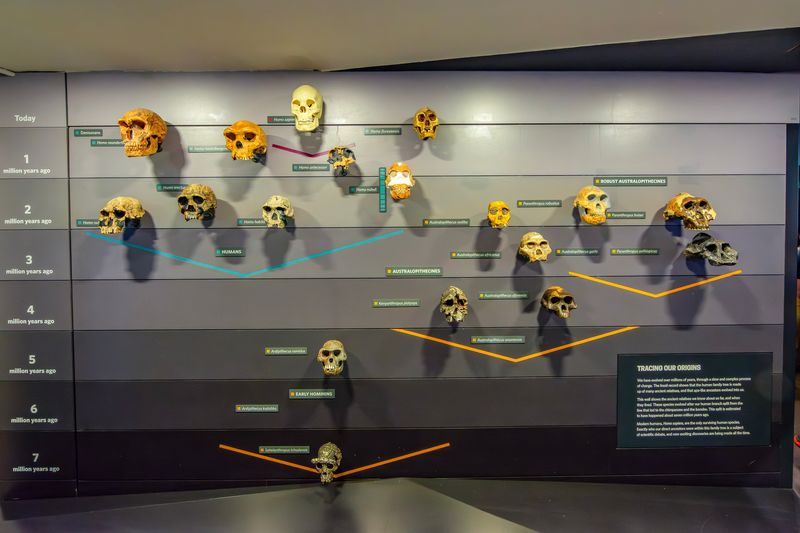
Using archaeological data on limb proportions and endocranial volumes in prehistoric hominins, the study authors were then able to simulate lateralization strength in our extinct ancestors. Their analysis indicates that handedness probably evolved gradually, and was relatively weak among the earliest bipedal hominins such as Ardipithecus and Australopithecus.
However, as our brain size increased, the rightward bias became increasingly potent. It’s likely that the trait was already fairly strong in Homo erectus and Neanderthals, but reached a peak in Homo sapiens. Conversely, handedness was probably weak among the Hobbit humans of Indonesia, reflecting the small brain size and partially arboreal lifestyle of this miniature member of the Homo genus.
“This is the first study to test several of the major hypotheses for human handedness in a single framework,” explained study author Dr Thomas A. Püschel in a statement.
“Our results suggest it is probably tied to some of the key features that make us human, especially walking upright and the evolution of larger brains,” he added. By looking across many primate species, we can begin to understand which aspects of handedness are ancient and shared, and which are uniquely human.”
However, while this study goes a long way to explaining why handedness exists in humans, it leaves a number of questions unanswered. For instance, it’s unclear why a small minority of us are left-handed, when evolution appears to have pushed us towards favoring our right hands.
The study is published in the journal PLOS Biology.