Nature
 PUBLISHED


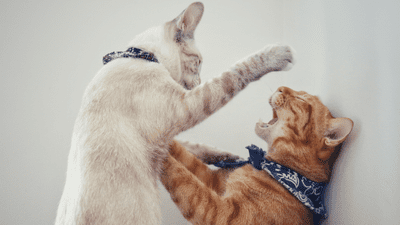


Cats love to fight, so much so that it’s one of the most common forms of play, but with the line between light-hearted scrapping and aggressive attacking so easily blurred beneath all that fur, how’s an owner to know when to take it seriously? Researchers on a new study decided to investigate the behaviors mostly commonly seen between cats who are playing and those who are aggressively fighting to find out.
They wanted to separate rough-and-tumble play from true agonism, a word derived from the Greek that means “struggle”. They say that telling the two apart can become even more complex when they become blended, for example, if two cats are playing but then one participant decides they’re not feeling it anymore and gets genuinely aggressive. However, they also argue it’s worth trying to muddle through the confusion in order to be able to provide the best care for our feuding felines.
“Successful interpretation of social interactions between cats is an important part of meeting standards for the wellbeing of co-habiting cats in multi-cat households and helps to reduce the risk of additional undesirable behaviours such as house soiling problems,” explained the authors. "Perhaps one of the most overlooked issues that often concerns owners is distinguishing rough and tumble social play from agonistic interaction in cats[…] There appears to be a blurred line between playful and agonistic aggression between cats.”
To get a clearer picture of the many types of cat battles, they observed 105 interactions between cats and classed them into three categories: playful, intermediate, or agonistic. The categorization was decided in two ways. Firstly, the researchers monitored the frequency and duration of six key behavioral elements, and secondly, they were assessed by cat behavior experts.
The results showed that not only were there consistent behaviors between the playful, intermediate, and agonistic groups, but that also the two approaches of categorizing each interaction landed on similar results. This meant they were able to identify common behaviors between cats that were playing for the fun of it, those that were somewhere in the middle, and those who meant business.
Cats that are play fighting tended to engage mostly in wrestling, but when things turned sour behaviors like chasing and vocalizing were more common. Those who were faux-fighting in the intermediate groups tended to more similarly mimic the behaviors of the playful group, though they did exhibit traits of both playful and agonistic cat couples.
“[Our findings] provide valuable practical evidence which can be used to help owners detect signs of inter-cat tension in its early stages,” concluded the authors. “Earlier detection and presentation to a clinical behaviour professional can be expected to be more likely to result in successful management of the relationship and prevent major issues which might lead to the relinquishment and/or euthanasia of one or both cats.”
The study was published in Scientific Reports.