Nature
 PUBLISHED

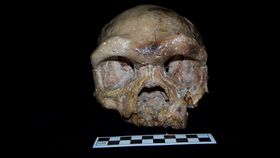


Every now and then there's a new piece of evidence that shakes up what we thought we knew about the origin of our species. Take, for example, the recent excitement over the European tooth fragments, which as one paleontologist told National Geographic is probably "much ado about nothing". The latest find to puzzle researchers is a 260,000-year-old skull, known as the Dali skull, that looks remarkably similar to the earliest known remains of Homo sapiens.
The problem is that the fossil is not where we would expect it to be. Archaeologists have unearthed comparable remains in Morocco, but this particular skull was found in Shaanxi, a province in northwestern China. The implication being that modern humans did not only originate from tribes in Africa but from human populations elsewhere.
The current consensus on human evolution is that Homo sapiens originated in Africa around 200,000 years ago. Available archaeological evidence suggests that anyone who does not have pure African ancestry descended from one single Homo sapien population (and maybe a handful of Neanderthals) that left Africa sometime in the past 120,000 years.
When researchers discovered the Dali skull, in 1978, they believed it belonged to another human species, Homo erectus. This particular hominin lived between 2 million and 100,000 (possibly 50,000) years ago in parts of Africa, Asia, and Europe. Like us, they walked upright and had elongated limbs.
By 1981, Xinzhi Wu from the Chinese Academy of Sciences, had noted an overwhelming number of similarities between the Dali skull and those of modern humans. He concluded there must be at least some shared DNA between Homo sapiens and Homo erectus.
That was more than 30 years ago and at the time his findings were dismissed. Now, Wu and colleague Sheela Athreya, an associate professor of anthropology at Texas A&M University, are taking another look at the skull.
“If we’d found only the Moroccan skulls, and not the Dali skull, it would make sense to keep believing all modern humans evolved in Africa,” Athreya told New Scientist. “But the similarities show that early modern humans may not have been genetically isolated from other parts of the world, like what we know today as China."
In fact, the new research suggests that many of the characteristics we have today could have originated in East Asia, arriving in Africa at a later date. This finding is so remarkable that, if proved to be true (and more testing needs to be done), it could have major implications on human evolutionary history.
“I think gene flow could have been multidirectional, so some of the traits seen in Europe or Africa could have originated in Asia,” said Athreya.
[H/T: New Scientist]