Space and Physics
 PUBLISHED





The nucleus of an atom stays together thanks to the strong nuclear force. This force acts on quarks, and despite leaps forward in our understanding, there is still plenty that needs to be uncovered about how it interacts with them.
It is easier to study heavier quarks, not the up and down quarks in our atoms but the exotic ones produced in particle collisions, and scientists at CERN’s ATLAS Collaboration have now reported the discovery of a new excited particle state made from these heavier quarks.
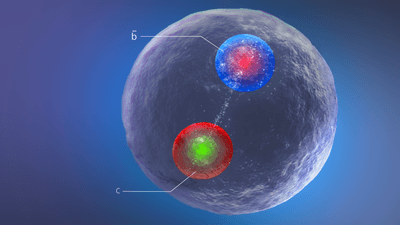
The particle in question is called Bc*+. It is made of two quarks. One is a charm quark, which is similar to the positive up quark found in our protons, but 550 times heavier. The other is a bottom antiquark (the antimatter equivalent of a bottom quark), which is over 1,800 times heavier than an up quark.
The asterisk in Bc*+ stands for the excited state of this particle, meaning it has extra energy compared with its ground (lowest-energy) state. That’s extremely good news for researchers, as excited states are heavier than ground states.
This particle is a meson, a class of particles made of just two quarks, unlike protons and neutrons, which have three. The excited version of this meson decays into a regular Bc+ meson and a photon, a particle of light. The mass difference between the two states is about 28 times the mass of an up quark. Extremely tiny for our standards, but measurable.
The measurement is within the range of theoretical expectations, but it shows a slight deviation from what high-precision modern calculations predict. Since the mass of this excited particle is related to the way the strong force behaves, if there is really a discrepancy, it could come down to the force not quite working the way we think it does.
These types of measurements aren't straightforward, however, especially because particles created inside the LHC are often too unstable to be seen directly. What scientists measure is slightly more stable particles that they decay into. By measuring the energy and momentum of these decay products, researchers can reconstruct what gave birth to them.
Take the photon produced in this decay. It isn't very energetic, so it is difficult to study with a detector like ATLAS, one of the four experiments of the Large Hadron Collider (LHC). The photon can turn into a pair made up of an electron and its antimatter counterpart, a positron, though, two particles that can be detected.
The same thing is true of the Bc+ meson, the ground state of the excited particle. The Bc+ meson is also unstable and decays into one muon and two antimuons – heavier cousins of the positron and electron – as well as an invisible particle, a neutrino.
Neutrinos are nicknamed ghost particles as they can travel through anything. This is due to their tiny mass and lack of electric charge, so interactions between them and other matter is rare. We have massive detectors to study them, like Super-kamiokande.
The team at the LHC doesn’t usually focus on decays that involve neutrinos because they are difficult to reconstruct. But in the case of the Bc+ meson, the decay with neutrinos is 20 times more frequent than others, so physicists had to rise to the challenge.
A paper describing the results was submitted to Physical Review Letters and is available on the ArXiv.