Space and Physics
 PUBLISHED



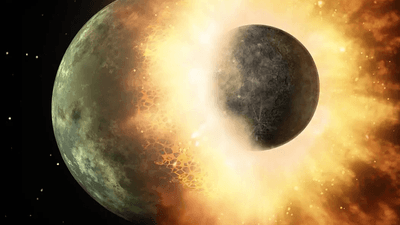


Inside our planet, there are the remains of another world. No, we are not peddling some conspiracy theory like the hollow Earth. We are talking about the remains of Theia, the Mars-sized object that, billions of years ago, hit our planet and led to the formation of the Moon. Its remains were simply incorporated with our planet but not completely. This is the bold idea that has acquired more and more evidence in recent years.
The impact between Earth and Theia may have literally left a big mark on our planet. There are two peculiar structures buried deep in the mantle, surrounding the Earth’s core. They are known as Large Low-Velocity Provinces (LLVPs). These anomalous formations are located beneath the African Tectonic plate and the Pacific tectonic plate. They are believed to have sunk as they are denser than the surrounding mantle material.
Their density depends on their chemical composition. Researchers used seismic waves as a sonogram of the Earth’s interior and found these denser regions. They believe they have more iron than the rest of the mantle and that’s where the connection came from. Dr Qian Yuan from Caltech was listening to a seminar given by Professor Mikhail Zolotov in 2019, when Zolotov explained the Gaia hypothesis and commented that the Moon is rich in iron like, presumably, Theia was.
"Right after Mikhail had said that no one knows where the impactor is now, I had a 'eureka moment' and realized that the iron-rich impactor could have transformed into mantle blobs," Dr Yuan said in a statement.
Detailed simulations showed that the scenario is a sound hypothesis. An impact with Theia would not completely devastate the planet, and much of the energy and material would remain in the upper mantle. There the "Theia blobs" coalesced and eventually sank to the bottom near the mantle-core boundary. The team compares this to lava lamp wax. If the lower mantle had been hotter, the LLVPs would have not existed, as the material would have mixed better.
The team is now investigating what consequence having these structures in the middle of the mantle during the formative years of our planet might have had on Earth’s geology. Our world is quite unique, geologically, compared to the other ones in the Solar System.
"A logical consequence of the idea that the LLVPs are remnants of Theia is that they are very ancient," Dr Paul Asimow said. "It makes sense, therefore, to investigate next what consequences they had for Earth's earliest evolution, such as the onset of subduction before conditions were suitable for modern-style plate tectonics, the formation of the first continents, and the origin of the very oldest surviving terrestrial minerals."
A paper describing the results is published in the journal Nature.