Space and Physics
 PUBLISHED
 21
21


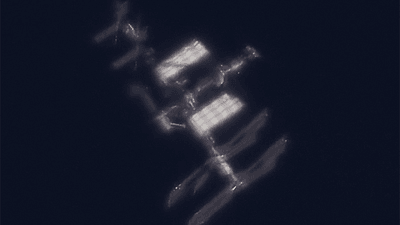


An amateur astrophotographer has captured an astonishing image of NASA astronaut Suni Williams conducting a record-breaking spacewalk outside the International Space Station (ISS).
Last week, NASA astronauts Suni Williams and Butch Wilmore – famously "stranded" on the ISS after faults on the Starliner spacecraft – left the safety of the space station to conduct scientific work outside of it. As well as being pretty cool work with an incredible view, the Extravehicular Activity was a record-breaker.
"Williams made history during last week's spacewalk," NASA explained in an Instagram post. "She surpassed former NASA astronaut Peggy Whitson’s record for total spacewalking time by a female astronaut. Williams now has 62 hours, 6 minutes of total spacewalk time, fourth on NASA’s all-time list."
While Williams took a selfie during the EVA, roughly 400 kilometers (250 miles) below, amateur astrophotographer and Screening Scientist at the University of Oxford, Charline Giroud, captured another angle of the walk.
Suni can be seen as a tiny blob, about 8 pixels wide, at the very end of the robotic arm
Charline Giroud
"I have been imaging the ISS with my telescope for almost four years as an amateur astrophotographer, and taking a picture of an astronaut during a spacewalk had been on my bucket list for quite a while," Giroud told IFLScience. "On Thursday, Jan. 30, I finally had the opportunity to capture such a picture as the ISS passed over the UK twice while astronauts Suni Williams and Butch Wilmore were outside the station on an EVA, working on a radio frequency group disassembly."
On the first attempt, the space station was obscured by clouds.
"However, the second pass was successful as the sky magically cleared up. While tracking the ISS, I was also watching the spacewalk broadcast on NASA TV. At the beginning of the pass, I saw Suni on the Canadarm-2, moving from the airlock platform to another work site. She was separated from the station wall and perfectly illuminated by the sun," Giroud continued.
"I knew she would be clearly visible in the final picture. It was the perfect move at the perfect time! Suni can be seen as a tiny blob, about 8 pixels wide, at the very end of the robotic arm. Unfortunately, Butch Wilmore was in the shade of the platform and isn’t visible in the image."

During the walk, Williams and Wilmore removed hardware outside the space station and collected samples of surface materials near life support system vents as part of the ISS External Microorganisms program.
"This investigation focuses on sampling at sites near life support system vents to examine whether the spacecraft releases microorganisms, how many, and how far they may travel," NASA explains of the program. "This experiment could help researchers understand whether and how these microorganisms survive and reproduce in the harsh space environment and how they may perform at planetary destinations such as the Moon and Mars. Extremophiles, or microorganisms that can survive harsh environments, are also of interest to industries on Earth such as pharmaceuticals and agriculture."