Humans
 PUBLISHED
 4
4




Nuclear weapons, we are told, keep us safe from enemies. Sometimes, though, things aren’t so clear. On a frankly embarrassing number of occasions, the US has either nearly, or actually, nuked itself – completely by accident. Let’s inspect the damage.
1958: the year it all went wrong
The first few years of nuclear weapon accidents – and we can’t believe we’re about to say this – weren’t that bad. Between 1950 and 1958, dozens of aircraft carrying nukes went down – but because of the way those early weapons were set up inside, major catastrophes were mostly avoided.
“The weapons of the day required mating a capsule of nuclear material with the bomb body itself,” explained Rebecca Grant for Air & Space Forces Magazine in 2012. “Airplanes often carried both weapon and capsule but rarely joined them together.”
“Such was the case in a 1957 incident where a B-36 was ferrying weapons from Biggs AFB, Tex., to Kirtland AFB, N.M,” she wrote. “On approach, the weapon dropped and fell through the closed bomb bay doors from a height of 1,700 feet. The blast blew a crater 25 feet wide and 12 feet deep, but luck held.”
But in 1958, something changed. In February, a B-47 lost a nuclear weapon off the coast of Georgia – the bomb has never been found, and reports still conflict as to whether or not it was a functional nuclear weapon. Then, a month later, a B-47 accidentally dropped a nuke on Mars Bluff, South Carolina – once again, in a stroke of incredible luck, the bomb happened to have no nuclear materials installed, and so the only damage was a mere 9-meter-deep (30-foot) crater, six injured bystanders, and a bunch of property damage.
In November, things got worse. On the 4th, a B-47 caught on fire while taking off from Dyess Air Force Base in Texas; the plane was carrying a full load of fuel and conventional high explosives inside of a nuclear weapon, and when it crashed, the two combined in an explosion strong enough to leave a crater 10.5 meters (35 feet) wide and 9 meters (30 feet) deep. The ground was contaminated with the nuke’s radioactive material, though how badly was classified.
Then, three weeks later, another B-47 caught fire without even taking off at all. The nuclear weapon on board was destroyed, contaminating the immediate vicinity of Chennault Air Force Base, Louisiana.
Things were bad. But they were about to get worse.
The five catastrophes of Operation Chrome Dome
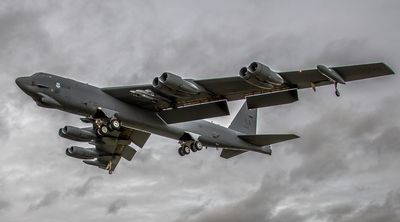
It’s hard to overstate just how paranoid the US was during the Cold War, but perhaps this will help put it in perspective: for nine years during the 1960s, the US Air Force had B-52 bombers in the air at all times – literally 24 hours a day, every day – flying routes that put them in position to attack targets in the USSR at a moment’s notice, just in case war broke out that day.
It was called “Operation Chrome Dome”, and as you might expect from the phrase “constant airborne thermonuclear weapons for almost a decade”, it was a pretty bad idea. Within a week of the Operation’s announcement in January 1961, the first accident had occurred: a B-52 broke up in mid-air over Goldsboro, North Carolina, dropping the two 3.8 megaton nuclear bombs it was carrying – a combined explosive power of more than 500 times the blast that destroyed Hiroshima, and enough to vaporize everyone and everything within a 27-kilometer (17-mile) radius.
“As the B-52 broke apart, its two Mark 39 bombs were released,” wrote Michael Hancock, an archives technician at the National Archives at College Park in Maryland, back in 2021. “One slammed into a muddy field at over 700 miles per hour and buried itself more than 180 feet deep. The other bomb’s parachute safeguard system operated as intended, and it touched down essentially undamaged, discovered hanging from a tree, the parachute preventing it from hitting the earth.”
Official reports at the time played the incident off as harmless – albeit not for the three crewmen who died in the crash – but the truth is, North Carolina came startlingly close to complete destruction. According to some statements, “five of the six steps (or six of seven) required for a thermonuclear detonation did occur,” Hancock wrote.
That was January. The next major Chrome Dome crash would come soon after, in March of the same year – this time in Yuba City, California. It was “caused by a string of errors beginning with a failure of cabin pressure,” reported Grant. “The B-52 descended to 10,000 feet, but suddenly the crew found they’d burned too much fuel to make it to their tanker, and had to bail out near Yuba City, Calif. Two nuclear weapons broke loose on impact.”
Both, when found after the crash, were in the beginning stages of arming themselves: their “pull out” rods had been extracted, and their timers were running. But both were so completely smashed up that explosion was basically impossible – not to mention the safety switches for both were in “safe” rather than “arm” position – and so, luckily, the bombs didn’t destroy California.
The third Chrome calamity came on January 13, 1964, when a B-52 carrying two 9-megaton nuclear bombs and five crewmen left Massachusetts for a night flight to Georgia. It was a wild night: a blizzard was raging across the Appalachian Mountains, causing turbulence so severe that the plane’s tail fin broke off in the air. Without its vertical stabilizer, the plane was uncontrollable; the crew bailed out, and the aircraft crashed into the remote, snowy mountains.
Three of the crew died, and, according to William Stevens, a safety engineer at Sandia National Laboratories who was on duty during the accident, “both bombs broke apart on impact.” He and his coworkers fretted over how dangerous the bombs might be in that state – but it was only after strenuous protests that the Air Force started to take more care with the removal process.
The final two crashes occurred in Europe rather than the US – but they were so bad that it’s worth mentioning them anyway. One was in Palomares, on Spain’s Mediterranean coast; a B-52 collided with a KC-135 refueling tanker aircraft, causing the bomber to break apart and release all four of its B28 thermonuclear bombs over the village. Two detonated on impact – the nuclear weapon didn’t trigger, but the conventional explosive did, so radioactive plutonium was dispersed across 2 square kilometers of terrain (that’s about the same size as all of Monaco, or three Disneylands). Despite cleanup operations by the US and Spain, there are still areas of Palomares contaminated by the material.
Finally, there was Thule – the accident that ended Chrome Dome for good. A B-52, flying on one of the program’s signature 24-hour airborne missions, had crashed into the Arctic sea near Thule base in Greenland, losing four nuclear bombs in the process. As in Palomares, the conventional explosive detonated, spreading radioactive material across the snow and ice.
“The Thule crash – with bombs loose on Greenland territory – was a diplomatic nightmare. Greenland belonged to Denmark, and Denmark had a nuclear-free policy,” explained Grant. It was one catastrophe too much: the morning after the Thule crash, Operation Chrome Dome was ended.
A wrench in the works
Chrome Dome might be over, but accidents will always happen – and one of the most famous “near misses” came in 1980, in Damascus, Arkansas.
“It started as a fuel leak,” said Randy Dixon, director of the David and Barbara Pryor Center for Arkansas Oral and Visual History, in 2025. “An airman had dropped a wrench down into the silo. […] It ricocheted off the sides and pierced the casing of the missile and caused a leak.”
There were 18 silos in rural Arkansas at the time, each housing a Titan II intercontinental ballistic missile armed with a nine-megaton nuclear warhead. “To put that in perspective […] the blast was three times more powerful than every bomb dropped during World War II, including Hiroshima and Nagasaki combined,” Dixon said.
An explosion of that size “would have devastated all of Arkansas and the surrounding states,” he said. “And not to mention the fallout, depending on which way the wind was blowing, could affect all the way to the East Coast or all the way to the West Coast, or north into Canada, or south into Mexico.”
But here’s the thing: all it would have taken for it to explode was for that fuel, now leaking out of the first-stage fuel tank, to hit the oxidizer in the second-stage tank directly below. Even worse: once the fuel tank was empty, it could collapse, causing the barrier between the stages to rupture anyway.
“Water was pumped into the seven-story subterranean compound, an effort to dilute and diffuse the highly volatile fuel. It didn't work,” reported local news at the time. “At about 3 o'clock, a quick series of explosions, red flames soaring into the night sky to heights that some observers said exceeded 300 feet […] the explosion blew the missile's warhead from the tip of the rocket and onto the ground outside the silo.”
It was a huge explosion – and an incredibly lucky escape. While the explosion destroyed the launch complex and claimed at least one life, no nuclear material was lost.
The Air Force did, however, retire the Titan II system.