Nature
 PUBLISHED
 12
12




Scientists have long been puzzled by the origins of eukaryotes, the group of life defined by cells with a membrane-bound nucleus that includes all animals, plants, and fungi. By uncovering how these organisms first arose, researchers hope to better understand the emergence of complex life.
One leading idea suggests that eukaryotes evolved between 1.6 and 2.2 billion years ago, evolving from archaea through an intimate symbiotic partnership with an oxygen-using bacterium.
Following this evolutionary trail, researchers have sought to identify the archaeal lineage that could represent the common ancestor of all eukaryotic life on Earth.
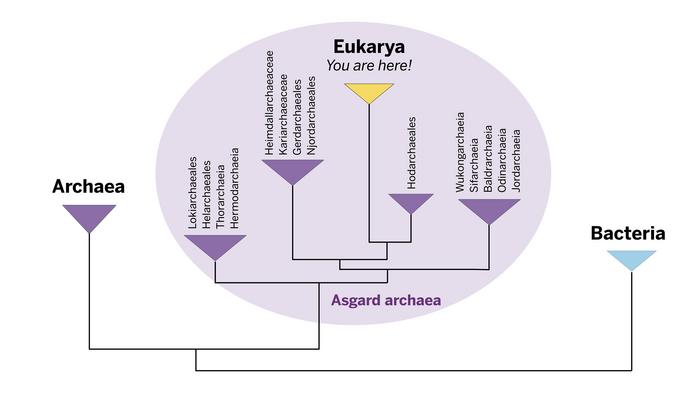
In 2023, scientists at the University of Texas at Austin made a major breakthrough. By analyzing the genomes of hundreds of archaeal microbes, they found that all known eukaryotes can be traced back to a single lineage of archaea known as the Asgard archaea.
The newly described lineage belongs to an order called Hodarchaeales (or “Hods” for short) found in marine sediments. Like other Asgard archaea, they contain proteins that were once thought to be exclusive to eukaryotes, hinting at their close evolutionary relationship.
“To me, the most exciting thing is that we’re starting to see the transition from what biologists think is an archaeon to this organism Hodarchaeales that is more like a eukaryote,” Brett Baker, study author and UT Austin associate professor of integrative biology and marine science, said in a statement. “Another way to put it is that these Hods are our sister group in the archaeal world.”
As you may have noticed, all of this is steeped in Norse mythology. Asgard is the heavenly realm of the principal gods, while Hod (or Höðr) is the blind son of Odin and Frigg, who is tricked by Loki into killing his own brother Baldr.
“I keep joking in my talks that ‘We are all Asgardian’. Now that’s probably going to be on my tombstone,” said Baker.
The Asgard archaea likely evolved more than two billion years ago, and their descendants are still alive today, buried deep within marine sediments and living in hot springs around the planet.
By studying these organisms, the scientists hope to uncover the mystery of how complex eukaryotic cells first emerged.
“Imagine a time machine, not to explore the realms of dinosaurs or ancient civilizations, but to journey deep into the potential metabolic reactions that could have sparked the dawn of complex life,” explained Valerie De Anda, study author and biologist at the University of Texas at Austin. “Instead of fossils or ancient artifacts, we look at the genetic blueprints of modern microbes to reconstruct their past.”
“This is really exciting because we are looking for the first time at the molecular blueprints of the ancestor that gave rise to the first eukaryotic cells,” De Anda said.
The study was published in the journal Nature.
An earlier version of this article was published in 2025.