Space and Physics
 PUBLISHED
 3
3



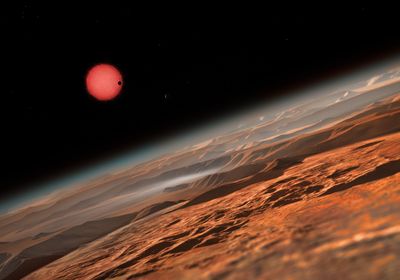


The most common stars in the universe are smaller and cooler than our Sun, but they can be a lot more violent when it comes to activities and intense ultraviolet radiation. Many rocky worlds have been found around these M-dwarf stars, but their temperamental behavior had researchers question their suitability for life. A new study argues that it is possible for these worlds to actually keep an atmosphere (if they follow a certain evolution).
The team behind the study modeled planets from their molten origin to the formation of a rocky crust and an atmosphere. The simulations showed the first atmosphere to form is likely destroyed by the star – but a second atmosphere could form, and the planets might be able to hold onto that one.
"One of the most intriguing questions right now in exoplanet astronomy is: Can rocky planets orbiting M-dwarf stars maintain atmospheres that could support life?" lead author assistant professor Joshua Krissansen-Totton, from the University of Washinton, said in a statement. "Our findings give reason to expect that some of these planets do have atmospheres, which significantly enhances the chances that these common planetary systems could support life."
The idea is that, as long as the planets are in the habitable zone and not too close to the star, they should be able to form water in their atmosphere quickly enough. At first, the molten planet would be shrouded in hydrogen and this would be blown away by the star – but in planets with a moderate temperature, hydrogen would combine with oxygen to form water.
Water and other heavier gases would then form an atmosphere that the simulations showed to be stable over time. These cooler planets, where rain forms quickly, have a more stable atmosphere.
The seven planets in the TRAPPIST-1 system are perfect examples of rocky worlds around an M-dwarf. JWST is currently studying them, but so far only data on the closest worlds have been published – and, as expected, they are unlikely to have an atmosphere.
"It's easier for the JWST to observe hotter planets closest to the star because they emit more thermal radiation, which isn't as affected by the interference from the star. For those planets we have a fairly unambiguous answer: They don't have a thick atmosphere," Krissansen-Totton said.
"For me, this result is interesting because it suggests that the more temperate planets may have atmospheres and ought to be carefully scrutinized with telescopes, especially given their habitability potential."
The paper is published in the journal Nature Communications.