Humans
 PUBLISHED
 6
6




It's a well-known fact that there's a lot of interspecies mingling in the human family tree. It's clear that modern humans have fragments of DNA from our ancient relatives, like the Neanderthals and the Denisovans, but it also appears that other mystery species live on in the genomes of some modern-day populations.
In January 2019, an international team of researchers examined human DNA using deep learning algorithms to analyze genetic clues to human evolution for the very first time. The results were published in the journal Nature Communications.
It's long been suspected that, further to the Neanderthals and Denisovans, people of Asian descent have a third ancestor that interbred with ancient humans. This finding would help explain the existence of certain DNA fragments that otherwise have no apparent origin.
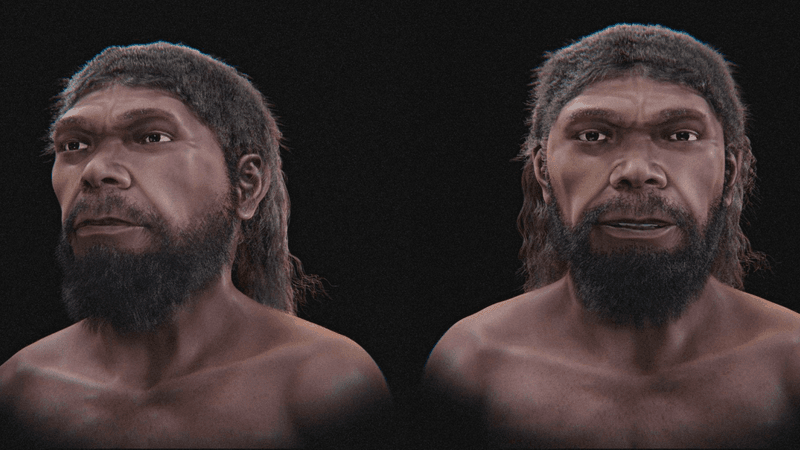
Those suspicions were seemingly confirmed by the 2019 research. This long-lost hominid was likely a Neanderthal-Denisovan hybrid, the researchers say, but little else is known about it.
"About 80,000 years ago, the so-called Out of Africa occurred, when part of the human population, which already consisted of modern humans, abandoned the African continent and migrated to other continents, giving rise to all the current populations," Jaume Bertranpetit, principal investigator at the Institute of Evolutionary Biology, said in a statement.
"We know that from that time onwards, modern humans crossbred with Neanderthals in all the continents, except Africa, and with the Denisovans in Oceania and probably in Southeast Asia, although the evidence of cross-breeding with a third extinct species had not been confirmed with any certainty."
The discovery came from the ability of deep learning or artificial intelligence (AI). This, the researchers say, has made it possible to transition from DNA to the demographics of ancestral populations – a task that would have been too complex and cumbersome to complete manually.
Òscar Lao, the principal investigator of the Centro Nacional de Análisis Genómico (CNAG-CRG) in Spain, compared the tech to the nervous system of mammals, with various different artificial neurons that learn to detect patterns in data.
"We have used this property to get the algorithm to learn to predict human demographics using genomes obtained through hundreds of thousands of simulations," Lao explained.
"Whenever we run a simulation we are traveling along a possible path in the history of humankind. Of all simulations, deep learning allows us to observe what makes the ancestral puzzle fit together."
The existence of this new ancestor is also supported by fossil evidence found in Siberia last August. The bone appeared to have belonged to a Neanderthal-Denisovan "love child" – or hybrid. While further analysis revealed the Denisovan father had at least one Neanderthal ancestor, suggesting this kind of interspecies mating was a more regular occurrence.
The researchers say the study implies the cross-species individual was not a one-off but instead, part of a process of introgression. However, they are not yet ruling out other possibilities.
An earlier version of this article was published in January 2019.