Space and Physics
 PUBLISHED


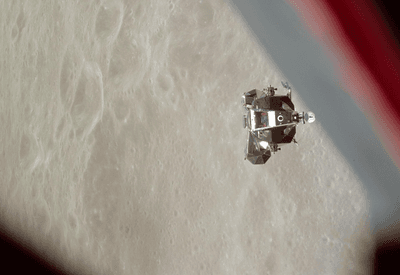


Getting to the Moon is hard, but you might think it was at least straightforward. However, new research shows that every mission there has used more fuel than was necessary, and after simulating 24 million different routes, scientists have now calculated the most efficient route yet for the future.
Plotting orbits to the planets is complex because you can use the gravitational boost from other objects for fuel efficiency. As fans of The Martian and For All Mankind know, sometimes that means the fastest way to Mars is via another planet, as counterintuitive as that seems to anyone used to oversimplified Solar System maps, which show Mars right next to us.
The journey to the Moon and back should be simpler, one would expect, since there’s nothing on the way with a useful amount of momentum for us to steal. Nevertheless, since the aim is to get into lunar orbit prior to landing, rather than slamming straight into its surface, there are so many factors in calculating the ideal route that both the Apollo and Artemis missions cut corners with the calculations. Now, physicists have used a mathematical approach known as the theory of functional connections (TFC) to evaluate 24 million trajectories for just the first stage of a two-stage journey.
The fuel required to get from one astronomical object to another is calculated, not in volume or weight that would vary with fuel type, but in terms of the change in velocity, or ∆V, measured in meters per second. If you want to know how much to load aboard, you need to know how much ∆V a unit of fuel will give you, given the mass of the spacecraft.
The most efficient lunar route Dr Allan Kardec de Almeida of the University of Coimbra and co-authors could find to get from low Earth orbit to lunar orbit requires 3,925 m/s. Large as that figure is, it’s 66.7 m/s less than the most efficient route anyone had found before. A saving of less than 2 percent might not appear to justify excitement, but de Almeida argues in a statement, "When it comes to space travel, every meter per second equates to a massive amount of fuel consumption.”
One response to finding a more efficient route is to add in a few precious but heavy items that were originally thought unaffordable, while keeping the rockets the same. However, an alternative approach is to maintain the same payload and use less fuel. Since every gram of fuel used later in the journey adds to the launch weight, requiring extra fuel to get off the surface, there’s a virtuous cycle that can make a big difference.
If the best path to the Moon was the most direct one, we’d have found it long ago. Instead, Almeida and co-authors calculate a spaceship should aim for the system’s L1 Lagrange point, where the Earth and Moon’s gravity cancel each other so objects can maintain their location with little effort.
Note that this is the L1 of the Earth-Moon system, not the Earth-Sun L1 where craft studying the Sun are parked.
The recommended path would not see the spacecraft park itself at L1, but instead circle around it, known as a Lyapunov orbit. The benefits of using L1 as a way station have been established previously, but earlier work assumed the ship should set itself on course there from near the Earth. The vast number of simulations turned up a more efficient option, going around the Moon and coming at the Lyapunov orbit from beyond the Moon by firing rockets at precisely the right times.
The lunar mission can then loop around L1 as long as it wants with only tiny fuel requirements to keep it stable, before transferring to lunar orbit. Besides the fuel saving, the vicinity of L1 preserves direct communication with both Earth and Moon, rather than losing both as happens when missions pass behind the Moon.
If saving fuel is the top priority, the path Almeida and co-authors propose is the best on average, but probably not under all circumstances. That’s because they only took into account the gravity of our planet and its satellite. Jupiter’s influence is probably not large enough to change things much, let alone the smaller planets, but the Sun is a different matter.
By factoring in the relative positions of Sun, Moon, and Earth on any specific day, the team expects that even more efficient options will sometimes appear, but only within a narrow timing window. “If we simulate the mission's launch date as December 23, we'll obtain results valid only for a mission launched on that date," Almeida said. However, the team’s methodology makes it relatively easy for others to pick a likely date and run the simulations until they find the best one.
Of course, if a technical hitch forces a delay, everything might need to be recalculated.
The path the team identified is not quick, taking a minimum of almost 32 days, even without the time to get into low Earth orbit and land on the lunar surface. Not only might that strain the patience of any humans on board, but the extra food and water required would eat into the weight savings on a crewed mission. On the other hand, the approach could be perfect for sending non-urgent cargo.
The study is open access in Astrodynamics.