Nature
 PUBLISHED
 4
4


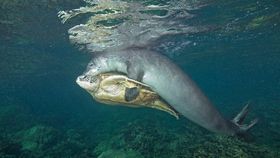


If you were to get up and walk a circle right now, it would probably resemble an asymmetrical, amorphous blob. Tracking perfect circles isn’t something humans do all that often, but new research has found it’s surprisingly common among marine animals. The study, published in the journal iScience, used tracking devices to follow the movements of several ocean-dwelling animals and found that they swim in circles surprisingly often. Puzzling, as we don’t currently know why.
The kit strapped to the ocean critters was able to take highly accurate measurements in a 3D plane, meaning it could keep up with their movements side to side as well as up and down. They were strapped to marine megafauna including turtles, sharks, seals, and dolphins – among others – and compared their swimming patterns. The affinity for swirly swimming patterns first became apparent during a displacement experiment, which saw researchers pick up nesting green turtles and letting them go in a different location to see how they navigate.
“To be honest, I doubted my eyes when I first saw the data because the turtle circles so constantly, just like a machine!” said study author Tomoko Narazaki of the University of Tokyo in a statement. "When I got back in my lab, I reported this interesting discovery to my colleagues who use the same 3D data loggers to study a wide range of marine megafauna taxa."
They decided to investigate if this bizarre affinity for circles extended across marine megafauna, and circular swimming species began to rack up. The finding is a confusing one, as swimming in straight lines would be a more logical and efficient way to get about, so what’s the deal with the circles?
There are a few behaviors that might benefit from circular swimming – from navigation using the Earth’s magnetic field, to foraging for food or searching for a mate. Different species were spotted using circular swimming in different scenarios. For example, a male tiger shark was found to be circling its way to a female for courtship, while turtles seemed to circle as a means of navigation.

"We've found that a wide variety of marine megafauna showed similar circling behavior, in which animals circled consecutively at a relatively constant speed more than twice," said Narazaki. "What surprised me most was that homing turtles undertake circling behavior at seemingly navigationally important locations, such as just before the final approach to their goal.”
The researchers next hope to investigate the movement and swimming patterns of marine megafauna whilst also monitoring their internal state in hopes it may provide insights to further demystify the mysterious behavior.