Space and Physics
 PUBLISHED





Picture yourself as a NASA rover on Mars. As the Sun lowers itself towards the horizon, the pinkish sky gives way to a blue sunset. If you were truly there, you might admire a night sky without any light pollution, something you can’t do on Earth. But for the rovers, nighttime is simply a time to stop working – with a few exceptions.
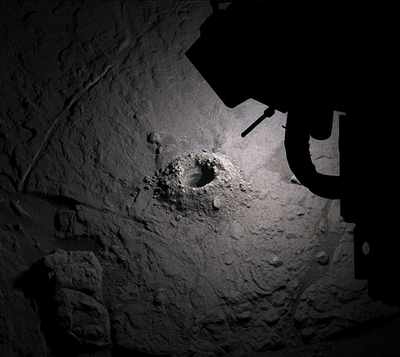
The latest from NASA’s Curiosity is the use of its LED light to better study a recently drilled hole. The rover has been boring rocks since it got to Mars in August 2012, and the LEDs are part of the Mars Hand Lens Imager or MAHLI. Curiosity was the first nuclear-powered rover on Mars, so it has no qualms in working with or without the Sun. Obviously, the question is the advantages of nightshifts.
One reason for the rover to work in the dark was the ability to see different layers in the hole drilled. That is how the MAHLI’s lights were used. It has been a while since that was done, though. Curiosity had to change its drilling approach, and the holes are usually too rough to get this illuminated analysis.
On December 6, 2025, Curiosity had a novel chance to work late when a hole in a rock called “Nevado Sajama” (drilled three weeks earlier) looked ideally smooth for those specific observations.
NASA’s Perseverance, the more advanced colleague of Curiosity on Mars, too, has been busy at night; in May 2025, there was the first-ever detection of visible light aurorae on Mars. This was a double whammy of excitement because it was the first detection of any type of aurorae from the ground on a planetary body other than Earth.
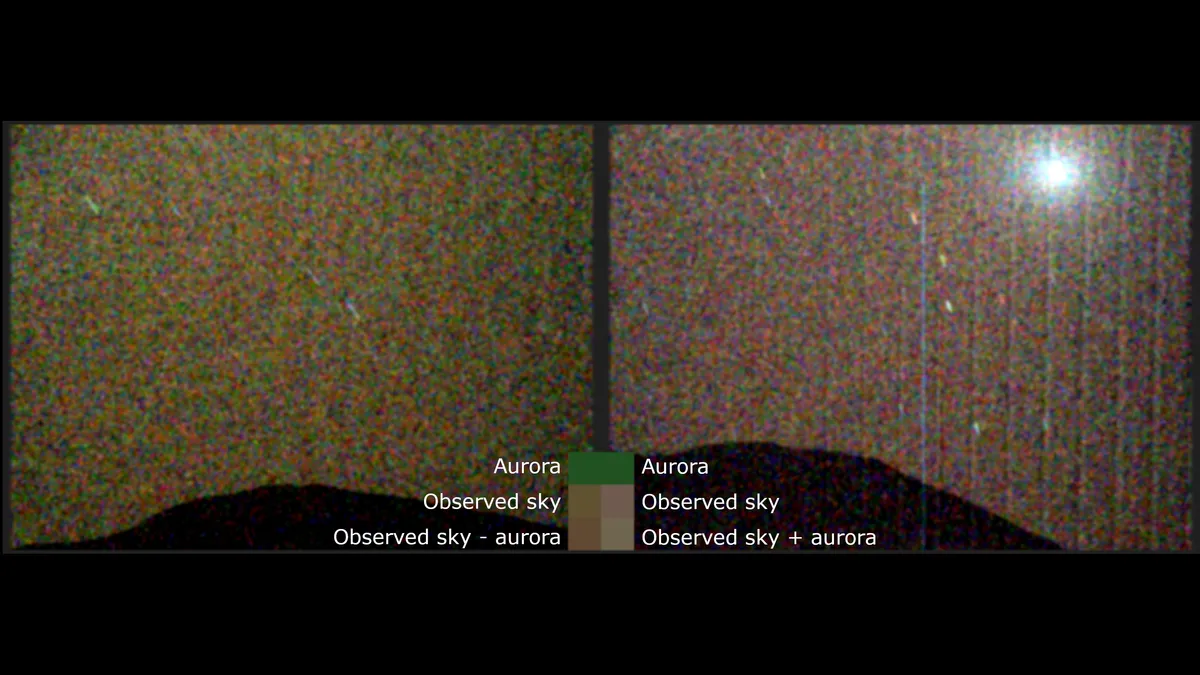
“For the first time ever, visible aurora has been observed on Mars. It was observed using two instruments on the Mars 2020 Perseverance rover, the SuperCam spectrometer and the Mastcam-Z camera,” lead author Dr Elise Wright Knutsen, from the University of Oslo, told IFLScience at the time.
Being used to the great astrophotography images of aurorae, the snaps from Perseverance look quite poor, of course. However, the rover was not designed for these kinds of observations of the night sky on Mars. This was even more obvious when Perseverance snapped images of interstellar comet 3I/ATLAS on Mars back in October. The interstellar object flew 30 million kilometers (18.6 million miles) from the Red Planet.
.gif "a cursor follows a small dot moving acros the sky in the animated image")
The comet is a little fuzzy spot in the sky; again, not the epic images we have seen of that or other comets. Still, this is a robot on another planet capturing a comet that could be twice as old as the Solar System.
The nocturnal work of the Martian rovers is clearly a precious and rare event, but it does deliver with impact.