Nature
 PUBLISHED
 5
5


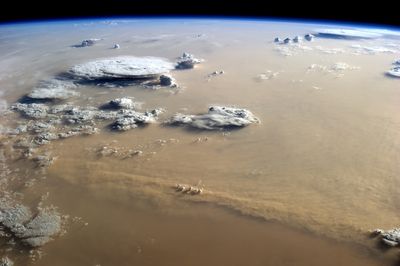


Among the many ways humans have looked to master this planet, few ideas can be considered bold and more batsh*t than plans to flood the world’s largest desert, the Sahara, and create a vast new “sea” in Africa. For centuries, this idea has been floated time and time again. Now, with the world facing a deepening climate crisis, this dangerous idea has experienced yet another renaissance.
To see how this plan might unfold, we only need to look at the Mediterranean Sea, which was created, at least as we know it, a little over 5 million years ago by the biggest megaflood the world has ever seen.
Today, the Mediterranean is known for its balmy temperatures and picturesque coastlines that are perfect for beachgoers. However, just under 6 million years ago, this patch of the planet was largely just a dried-up basin caked in salt. If you happened to be around at this time, it would have been theoretically possible to walk from southern Europe straight to North Africa across this great salty plane.
This unusual situation arose around 6 million years ago when the Mediterranean Sea was cut off from the Atlantic Ocean. It’s not totally clear how and why this happened, but most explanations involve gigantic tectonic forces and the lowering of sea levels.
Prior to the crisis, sea levels had dropped about 70 meters (over 200 feet), making it harder for the Atlantic Ocean to flow into the Mediterranean. Paired with this, some argue that tectonic forces were at play around the Strait of Gibraltar, effectively raising the seafloor and creating a dam wall between Southwestern Europe and northwestern Africa.
As centuries passed, evaporation exceeded rainfall and the Mediterranean dried out. Scientists called this the Messinian salinity crisis.
Scientists believe the situation was resolved by the Zanclean flood, a theorized flood of water that reconnected the Mediterranean Sea to the Atlantic Ocean around 5.33 million years ago. Thanks to this new influx of water, the Mediterranean was eventually turned from a salt-ridden wasteland into a beautiful ecosystem, beaming with biodiversity.

As far back as the 19th century, ambitious thinkers have dreamt whether it would be possible to create an event like this in the Sahara, creating an inland “Sahara Sea” that would turn the area from a barren desert into a lush land. Its proponents argue that this could bring a wealth of economic and humanitarian benefits, not to mention military advantages (for the lucky ones).
One of the first to draw up the plans was Scottish engineer Donald McKenzie who proposed flooding the El Djouf basin in 1877. He argued that a 644-kilometer (400-mile) long channel from Morocco into the Sahara basin could create an inland sea of around 155,400 square kilometers (60,000 square miles), roughly the size of Ireland.
Similar proposals arose in the following decades and the idea of the “Sahara Sea” even serves as the setting of the 1905 novel Invasion of the Sea written by the "father of science fiction" Jules Verne.
The idea continued to spark imaginations throughout the 20th century. Egypt has continually flirted with the plan to build a canal from the Mediterranean Sea that leads to the Qattara Depression to create an artificial lake amid the sand dunes. The theory is that it would transform the landscape while generating heaps of hydroelectric power from the steady flow of water.
Now in the era of climate change, some are toying with the “moonshot” idea of sea flooding yet again. One such proposal has suggested flooding the Middle East’s Dead Sea, which is found at the borders of Jordan, the West Bank, and Israel. This could be done by passively piping water from the Mediterranean or the Red Sea to the Dead Sea Depression.
Its advocates argue this would change the Dead Sea depression into a thriving ecosystem, much like how the Zanclean flood transformed the Med. In turn, it would foster the growth of forests, microalgae, and other plant life that would help to capture carbon and mitigate climate change.
Needless to say, any geoengineering project on this scale has the potential to go very wrong. Scientists, on the whole, are very skeptical about geoengineering’s potential to address climate change, let alone the many unforeseen risks it may entail.
Even Y Combinator, a US startup accelerator that's shown interest in “desert flooding”, has conceded it is “risky, unproven, even unlikely to work”.
Desert flooding is evidently a tempting idea, as shown by the heaps of interest it has attracted over the past 150 years, but it certainly feels like it’s best left to the sci-fi novels for now.