Technology
 PUBLISHED


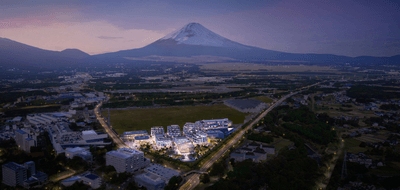


In the shadow of Mount Fuji, a new city is being built by Japanese car maker Toyota called “Woven City.” It’s been described as a “living laboratory” designed to investigate how urban inhabitants can live in tandem with autonomous vehicles, robots, clean energy, and artificial intelligence (AI).
So-called smart cities, often surrounded by starry-eyed hype and savvy PR, have a fairly bad track record of ever getting off the ground. However, it appears that Woven City is actually going somewhere (well, that’s according to their savvy PR).
Construction started in early 2021 and is set to finish in summer 2024. By 2025, the city hopes to soft launch and begin its "demonstration trials". These demos will include experiments involving next-generation remote communication technologies and “smart logistics” involving smartphone apps linked to delivery robots.
Inside the city's homes, robotics and sensor-based AI plan to be used for everyday tasks like automatically restocking the fridge and taking out the trash.

Toyota explains that the city will initially be home to around 360 people, mainly senior citizens and families, but plans to gradually expand its population to around 2,000. The residents will include employees of the company such as technicians and researchers, who will observe the settlement and develop technologies such as AI in a real-world environment.
All of this will occur against the backdrop of an urban environment built by robots, inspired by the natural world and traditional Japanese woodwork. To aid the city’s design, the company has also employed the help of famous Norwegian architect Bjarke Ingels.
"Building a complete city from the ground up, even on a small scale like this, is a unique opportunity to develop future technologies, including a digital operating system for the city's infrastructure,” Akio Toyoda, chairman of the Toyota Motor Corporation and the company's former president and CEO, said in a statement in 2020.

“With people, buildings and vehicles all connected and communicating with each other through data and sensors, we will be able to test connected AI technology... in both the virtual and the physical realms... maximizing its potential," he added.
Akio Toyoda is a great-grandson of Sakichi Toyoda, the so-called "King of Japanese Inventors" who founded Toyota Industries in 1926 as a manufacturer of automatic looms. Although the company has since expanded beyond loom-making, the name “Woven City” appears to be a reference to this legacy.
“If you didn't know, Toyota actually began as a loom manufacturer. We didn't start by building cars. We began by weaving fabric. Now, we hope to use our technology to weave together a new kind of city and a new way of enjoying life,” Akio Toyoda said at a press conference.