


 Space and Physics
 PUBLISHED


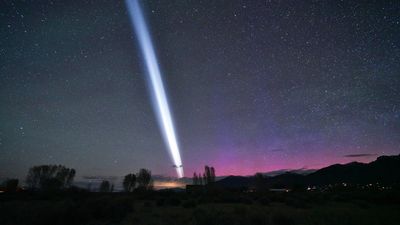


While photographing the auroras during a geomagnetic storm, Mike Lewinski caught sight of something extraordinary: a brilliant white beam of light tearing through the night sky.
He was shooting from the quiet town of Crestone, Colorado, on May 16, as a moderate geomagnetic storm rippled across the Northern Hemisphere.
Celestial events like this occur when the Sun releases a burst of solar wind, disturbing Earth's magnetosphere. If you're fortunate, that disturbance can trigger a vivid auroral display in regions much farther south than usual, offering astrophotographers a rare chance to capture the dazzling beauty of the Northern Lights.
But even with that in mind, Lewinski likely never expected what appeared next.
"The aurora was rippling low on the northern horizon when suddenly a bright streak of light, reminiscent of a rocket re-entry, appeared high in the sky and flowed down to the horizon," Lewinski told Spaceweather.com.

His suspicions are probably on the mark. Just an hour before, on the other side of the planet, China's LandSpace Technology launched six satellites into orbit from the Jiuquan Satellite Launch Center in the northwest of the country.
A bunch of other keen-eyed skygazers also caught sight of the light beam. Many hoped they might have observed a rare glimpse of STEVE, the unusual purple aurora-like phenomenon that can cause interesting light patterns in the sky. It’s a great guess, but they’re sadly wrong this time.
Commenting on social media, astronomer Jonathan McDowell confirmed the “unusual luminous cloud” was created by a fuel dump from the rocket’s upper stage at an altitude of around 250 kilometers (155 miles). Using data from Space-Track, McDowell showed the Chinese rocket passed over the Western US between 05:24 to 05:28 UTC (11.24 to 11.28 pm MDT), not far from where Lewinski was capturing images in Colorado.
Rocket launches are no strangers to leaving behind spectacles of light in the sky. With China, American private companies, and other nations racing to populate our planet with massive satellite megaconstellations, the pace is astonishing. On some days, dozens and dozens of satellites can be put into orbit within the space of 24 hours.
There are clear benefits to this surge in activity, namely improved internet access in far-flung regions and enhanced data collection of the natural world. But amid the dazzling light shows and progress, we should not lose sight of the significant environmental and social costs these ever-escalating launches may carry.



 1
1