Nature
 PUBLISHED
 1
1



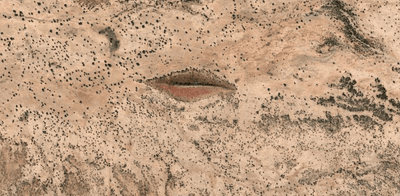


Be careful when scrolling through satellite images of Northeast Africa; you may find yourself suddenly seduced (if rocky hills are your thing, that is). Buried in the sticks of Sudan’s West Darfur state, a geological formation has been captivating armchair explorers on Google Earth for years. Viewed from above in satellite images, it bears an absurdly strong resemblance to a pair of puckered human lips.
Known as the "Landlocked Lips", it measures just under 1 kilometre (3,280 feet) from end to end, with a breadth of around 350 metres (1,150 feet). Scroll around, and you won't find a nearby nose or a chin to complete the face. That said, on the other side of Africa, in the deserts of Mauritania, there's the Eye of the Sahara. Who knows, perhaps there’s an ear lurking somewhere in Zambia, and another under the Mediterranean.
The illusion is formed by a rocky hillside topped with a sharp, prominent ridge. Thousands upon thousands of years of wind erosion have slowly sculpted the rock into an oval-shaped mound. Meanwhile, it has become lined with a rocky spine down the middle that is possibly a dike, an irregular seam of tough rock that sits vertically within a bed of softer rock.
In some cases, dikes like this are caused by the vertical intrusion of magma from below flowing upward through a crack in the surrounding earth millions of years ago, like toothpaste squeezed out of a tube. Once hardened, this intruding rock is tougher than the material around it, so it weathers more slowly and remains solid long after the softer hillside has been worn down by erosion.
There is apparently a campsite on the hillside, according to Google Maps, although we’d venture to say your chances of seeing the site with your own eyes are rather slim.
Bordering both Chad and the Central African Republic, West Darfur is remote, badly connected, and regularly wracked by political violence. Since 2023, it has been a hotbed of ethnic cleansing in the ongoing Sudanese Civil War that has resulted in the deaths of thousands of people and the displacement of hundreds of thousands more.
Given this grim backdrop, it's unsurprising that little is known about the formation's geological history, and there are no known ground-level photographs of the structure, although it presumably looks like an unremarkable hill from below.
What’s clearer is why our brains find the image of the lips so difficult to unsee: a phenomenon called pareidolia, the brain's tendency to find faces in random patterns. Scientists suspect this is an evolutionary hangover from the days when our ability to quickly discern faces in the distance could mean life or death. It's this reason why people might see the figure of Jesus on their burnt toast or, in this case, a human mouth in the Sundanese landscape.
The most striking images of the Landlocked Lips date from 2006, when the parched landscape highlighted the formation in sharp relief. In wetter years, when vegetation softens the surrounding terrain, the resemblance becomes far less convincing.
However, perhaps when drier weather returns, these perishing lips may return to West Sudan once more. Pucker up!