Humans
 PUBLISHED


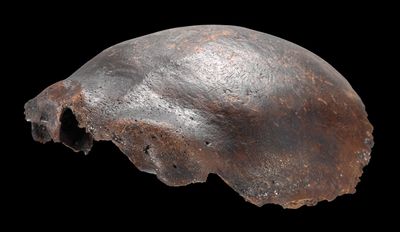


Back in 1973, archaeologists in Germany uncovered part of a human skull that wasn’t associated with any cultural artifacts, and therefore couldn’t be easily identified. However, after analyzing the specimen’s morphology, researchers noted that it showed a mix of Neanderthal and modern human traits, and therefore suggested that it may represent a hybrid of these two species.
Discovered in Hahnöfersand, the frontal bone was later subjected to radiocarbon dating, yielding an age of 36,000 years. This ties in perfectly with the hybrid theory, as Neanderthals and Homo sapiens are known to have interbred at roughly this time.
However, subsequent studies have shattered this idea, indicating that the Hahnöfersand bone is probably no older than 7,500 years old, and therefore belongs to an individual who lived during the Mesolithic, tens of millennia after the Neanderthals became extinct. Despite this, the specimen is still often referred to as a Neanderthal-sapiens hybrid in the academic literature.
That should stop now, though, as researchers have finally put the uncertainty to bed. Using a three-dimensional comparative analysis approach, the study authors sized up the Hahnöfersand frontal bone alongside numerous Neanderthal and H. sapiens specimens of different ages, and found that it falls firmly within the modern human variation.
“Multivariate analyses show a clear and unequivocal morphological affinity between Hahnöfersand and H. sapiens,” write the researchers.
Previously, other scholars had suggested that the Hahnöfersand frontal bone may be somewhat “extreme” for a modern human, thus giving the impression that it possesses a mix of Neanderthal and H. sapiens characteristics. However, the new analysis shows that medieval modern human skulls actually display similar proportions to this prehistoric specimen, which may therefore not be so extreme after all.
“Our results show that the frontal bone from Hahnöfersand, Germany, is most similar to Holocene H. sapiens, consistent with its revised Mesolithic date,” conclude the study authors. “Hahnöfersand does not exhibit an intermediate morphology between Neanderthals and H. sapiens, contrary to previous assessments of its morphology,” they add.
Given the specimen’s age of just 7,500 years, such a finding is hardly surprising. For genuine Neanderthal-modern human hybrids, you have to look much further back, to a time when the two species lived side-by-side and produced shared offspring.
In the Middle East, for example, hominins that buried their dead in caves some 100,000 years ago are thought to represent a mash-up of these two populations, and may have shared culture as well as genes. In Western Europe, meanwhile, contact between Neanderthals and H. sapiens occurred much later, producing a hybrid population that may have persisted until a little under 30,000 years ago.
The study is published in the journal Scientific Reports.