Humans
 PUBLISHED
 4
4


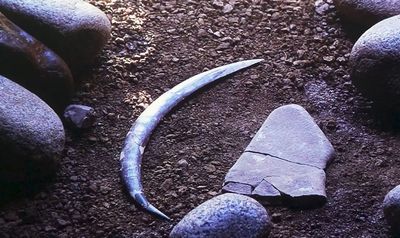


Around 42,000 years ago, Homo sapiens in Europe ushered in a type of prehistoric Renaissance known as the Aurignacian, characterized by the appearance of artistic creations and aesthetically refined tools in the archaeological record. Among the most striking finds from this cultural movement is the probable world’s oldest boomerang, exquisitely carved from a mammoth tusk and discovered in a cave in Poland, where it was likely used in some sort of ritual.
“This find is unusual in the European Paleolithic record as it is widely believed that Aboriginal hunter-gatherers invented the first boomerangs thousands of years ago as toys and weapons for survival in the challenging Australian environment,” write the authors of a new study about the ancient artifact. However, while the oldest boomerangs in Australia are around 10,000 years old, the researchers dated the Polish relic to between 42,290 and 39,280 years ago.
Discovered at a site called Obłazowa Cave in 1985, the artifact closely resembles the so-called Queensland boomerang – which does not return to the thrower – and experimental simulations have revealed that it behaves in a similar fashion to this Aussie invention. The item was previously dated to around 18,000 years ago yet has now been confirmed to hail from the Early Aurignacian, making it the world’s earliest known boomerang.
The study authors also note that while most Stone Age boomerangs are made of wood, this specimen is completely unique in its ivory composition.
Such a combination of elements in this cluster should be treated as evidence of the rituals of early Homo sapiens.
Professor Paweł Valde-Nowak
In close proximity to the boomerang, archaeologists also found a human finger bone as well as lithic artifacts typical of the Aurignacian. “It has been suggested that the human fossils and the boomerang may have been part of a shamanistic ritual,” write the researchers, adding that this interpretation is supported by ancient rock art across Europe depicting human hands with missing fingers.
“We know from [Australian] Aboriginal [cultures] nowadays that there is a kind of ritual to cut their fingers […] and this led the archaeologist that excavated the site to think that this is a ritual object rather than a hunting weapon,” said study author Professor Sahra Talamo to IFLScience.
This idea is supported by the fact that no other ivory pieces were found at Obłazowa, indicating that the boomerang was not made at the site but was transported from elsewhere, thus suggesting that it was a highly prized item.
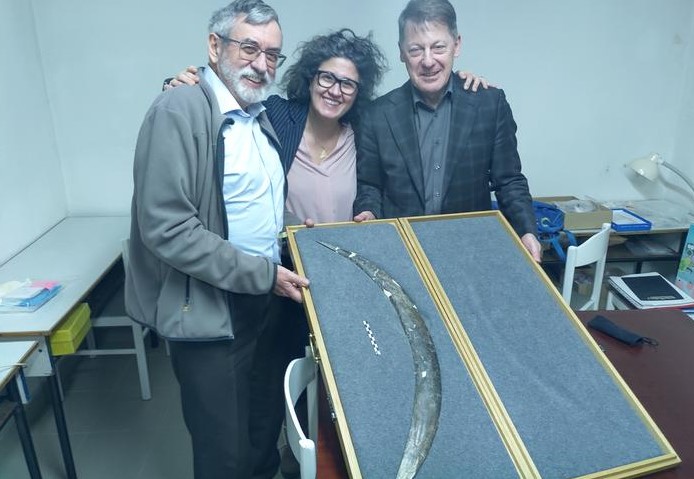
In an email to IFLScience, study author Professor Paweł Valde-Nowak explained that the boomerang was found among a scattering of boulders – each weighing some 60 kilograms (132 pounds) – that had been brought into the cave from a nearby riverbed. “In this arrangement of boulders, there were also objects of exceptional importance to Palaeolithic people – ornaments made of Arctic fox tusks, alleged whistles from fossil Conus shells (which were cut), stone artefacts from rocks occurring up to 300 kilometres (186 miles) away, and ochre,” Valde-Nowak said.
“Such a combination of elements in this cluster should be treated as evidence of the rituals of early Homo sapiens, not just in terms of knowledge of a throwing weapon, such as a boomerang,” Valde-Nowak added.
Yet as Talamo points out, these conclusions raise a number of questions regarding the nature of these mysterious practices. “If there was a ritual, we should have found such boomerangs all over Europe… but no other sites with a boomerang like this have been found,” she says.
“So why don't we have any other objects like this at this time period? The only answer we have at the moment is that we haven’t excavated enough sites.”
The study is published in the journal PLOS ONE.