Space and Physics
 PUBLISHED


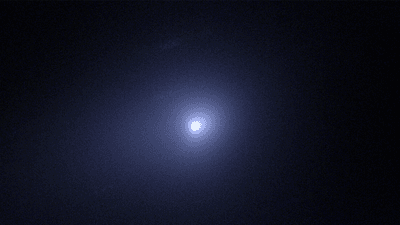


Observations from the Subaru Telescope located at the Mauna Kea Observatory on Hawai'i appear to show that the coma of interstellar comet 3I/ATLAS has changed as it made its closest approach to our star.
3I/ATLAS was first discovered in July 2025, hurtling through our Solar System on an escape trajectory. It was quickly determined to be an interstellar object, which is only passing through our neck of the cosmos, perhaps on its first close encounter in millions, or even billions, of years.
While it displays many classic cometary behavior, and it is certainly a comet, it has also been shown to differ significantly from the Solar System comets we are used to, for example developing an "anti-tail", very rarely seen in more local comets.
One particularly intriguing difference came when analyzing the composition of its coma using the JWST, which can be used to gain clues as to the composition of the comet's nucleus.
"The ratio measured for the amount of CO2 gas relative to H2O is among the highest ever observed in a solar system comet, demonstrating that the coma of 3I/ATLAS is very CO2-rich," NASA explained, prior to this new paper. "This may indicate that 3I/ATLAS was exposed to higher levels of radiation than comets from inside the solar system or that it formed in a region of its original planetary disk where CO2 ice naturally freezes out from the gas."
Those observations were taken on August 6, 2025, prior to perihelion, 3I/ATLAS's closest approach to the Sun on October 29. On January 7, 2026, the Subaru Telescope was able to observe the comet, allowing astronomers led by Yoshiharu Shinnaka of the Koyama Space Science Institute, Kyoto Sangyo University, to once again estimate the carbon dioxide (CO2) to water (H2O) ratios.
Using well-established methods for making these estimations, the team found a much lower ratio of CO2 to H2O than previously observed. It was still higher than most Solar System comets, but comparable to our second interstellar visitor 2I/Borisov.
The team suggests that this change is consistent with the hypothesis that the interior of 3I/ATLAS differs from the exterior. As the object heated up, gas from further inside the comet may have begun to escape.
"One plausible, though not unique, explanation is depth-dependent radial heterogeneity, in which CO2- and CO-enriched near-surface layers dominate the pre-perihelion activity, while deeper, more H2O-rich material contributes more strongly after perihelion," the team explains in their paper. "Additional observations of 3I at different heliocentric distances, together with thermophysical and compositional modeling, will be needed to clarify the origin of the observed pre- and post-perihelion differences in volatile composition."
A previously-suggested possibility is that galactic cosmic rays may have converted carbon monoxide into CO2, creating an organic-rich, irradiated crust on the comet's nucleus over the course of around a billion years. If that is the case, it might not be great news, making it more difficult to learn about the composition of objects that formed around other stars. But astronomers will no doubt find a way to do so, as we discover more of these interstellar objects.
"With the full-scale operation of survey telescopes in the coming years, many more interstellar objects are expected to be discovered. By applying the observational and analytical techniques we have developed through studies of Solar System comets to interstellar objects, we can now directly compare comets hailing from both inside and outside the Solar System and explore differences in their composition and evolution," Shinnaka said in a statement.
"Through studies of such objects, we hope to gain a deeper understanding of how planetesimals and planets formed in a wide variety of stellar systems, including our own Solar System."
The study is accepted for publication in The Astronomical Journal and is available as a preprint on arXiv.