


 Health and Medicine
 PUBLISHED


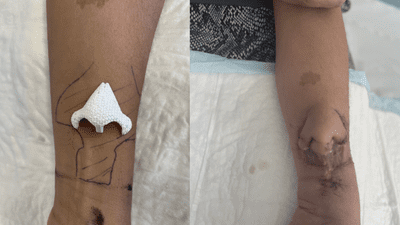


A transplant success story from Toulouse University Hospital (CHU de Toulouse) and the Claudius Regaud Institute was able to give a woman a new nose after losing hers to cancer. The nose was grown by creating a mold using a 3D printer that was then implanted into the forearm to grow blood vessels.
The patient was receiving treatment for a type of cancer called squamous cell carcinoma which had emerged in her nasal cavity. Her cancer was treated with radiotherapy and chemotherapy, but unfortunately, a large part of her nose and palate were damaged by the therapies.
Efforts were made to replace the nose through reconstructions and facial prostheses (humankind has a long history of face-making like this), but none were found to be appropriate for the patient. Then, a new technique using cutting-edge technology was tried.
Scientists were able to recreate the nose by 3D printing a biomaterial that’s used in medicine to replace all or part of organs and bodily tissues. While the technique had been used before, nobody had tried it as a way of growing a nose.
One obstacle they faced in growing the nose was a lack of blood vessels, but by implanting the 3D-printed transplant into the patient’s forearm, they were able to overcome this. After two months in the forearm, the nose developed its own blood circulation that could be severed and reconnected to the face using microsurgery to link up the vessels.
“Particularly fragile, the creation and 3D printing of the nose was made possible by the collaboration between medical teams and the company Cerhum, a Belgian manufacturer,” wrote CHU de Toulouse on Facebook. “Today the transplant is a success. After a forearm feeding and a two-month colonization of the medical device, the device was able to be transplanted into the nasal region and successfully revascularized.”
The nose is in good company in 2022, as earlier this year 3D printing was also used to create an ear for a patient with microtia, a rare congenital that causes the outer ear to be underdeveloped or absent. The technique is said to avoid implant rejection as well as achieving a natural appearance.
Another transplant success story saw the world’s first 3D-printed titanium jaw implanted into a patient after it was built from CT scans, making it a perfect fit. The medical achievement is just one of many ways in which modern medicine is finding ways to alter the human form, something we touch on in Issue 5 of CURIOUS, our e-magazine, as Tom Hale explores the complex history of transhumanism. Read all about it here.



 1
1