Space and Physics
 PUBLISHED



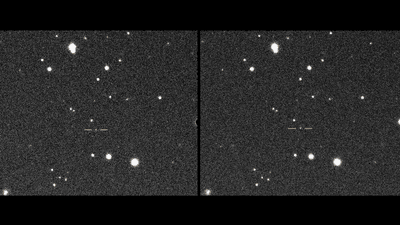


We have mapped and discovered a large portion of the most dangerous asteroids in the Solar System, but there is a glaring omission, with glaring being the operative word. Asteroids that orbit the Sun much closer than the Earth can be lost in the glare of our star. It's painstaking work to find them, but now astronomers report the discovery of the second space rock within Venus’ orbit and the second-fastest known asteroid in the Solar System.
The object is known as 2025 SC79, and it is 700 meters (2,297 feet) across. It goes around the Sun every 128 days, and it even crosses the orbit of Mercury. First observed on September 27, this object is only slightly slower and smaller than 2021 PH27, which holds the record for speediest rock by going around the Sun in 113 days.
"Many of the Solar System’s asteroids inhabit one of two belts of space rocks, but perturbations can send objects careening into closer orbits where they can be more challenging to spot,” discoverer and Carnegie Science astronomer Scott S. Sheppard said in a statement. “Understanding how they arrived at these locations can help us protect our planet and also help us learn more about Solar System history.”
The discovery was serendipitous and caused a bit of work to spread into Sheppard's holiday plans.
"It was very exciting to discover 2025 SC79. I actually observed the night before I was to leave on a hiking trip and discovered the new asteroid 2025 SC79 that morning as I looked through the new data," Sheppard told IFLScience.
"Because this asteroid was moving so fast, I instantly knew it had to be close to the Sun, but also, this object needed to be re-observed within a few nights to confirm it as real and to obtain its orbit before it was lost behind the Sun. Thus I had to schedule new observations to reobserve the object while deep in the forest of Pennsylvania. It is just amazing that even campsites today have good wi-fi access that allowed me to download the new second observations of this asteroid and determine its unique orbit that is interior to Venus."
The object and its predecessor are considered twilight asteroids. The name comes from the fact that they can only be observed at twilight, once the Sun has set, just like we observe Venus and Mercury. These two objects are large as Near-Earth asteroids go, suggesting that there are likely many others out there, hopefully not quite as big and hopefully nothing that crosses Earth’s path.
“The most dangerous asteroids are the most difficult to detect,” Sheppard explained. “Most asteroid research finds these objects in the dark of night, where they are easiest to spot. But asteroids that lurk near the Sun can only be observed during twilight – when the Sun is just about to rise or set. If these ‘twilight’ asteroids approach Earth, they could pose serious impact hazards.”
This is truly just the beginning of our discovery of a new population of space rocks.
"There appears to be many twilight asteroids yet to be found as we are only scratching the surface to look for these objects. Most of the time, because of projection effects of their orbits onto the sky, the near-Sun asteroids are obscured by the Sun’s glare, but every now and then the Earth and asteroid line up in a way that the asteroid appears far enough away from the Sun at the right time that we can view it from Earth. So we have to keep covering as much sky as possible in twilight waiting for these near-Sun asteroids to poke their heads out," Sheppard told IFLScience.
Good thing, then, that there are a lot of plans for this search with old and new observatories.
"We are continuing our search for Twilight Asteroids using the Dark Energy Camera on the NSF Blanco 4 meter telescope. The new Vera Rubin telescope will also look in twilight for asteroids starting next year, so we hope to find more of these twilight asteroids in the near future."
Astronomers won’t be able to track this asteroid for a while, as it will be behind the Sun from our point of view. In a few months, they will conduct follow-up observations to try and understand the composition of this world and how it can survive so close to the Sun.
Amendment 27/10/2025: This story has been updated to include quotes from Dr Sheppard.