Humans
 PUBLISHED




When the person who shot Charlie Kirk etched the phrase “hey fascist! CATCH!” into one of his bullets, he was likely referencing something ultra-modern: an online meme from a 21st-century videogame set in a 22nd-century galaxy. But a new find from the ancient remains of Hippos, not far from the Sea of Galilee, has shown he was also doing something incredibly old: inscribing violent, sarcastic instructions into ammo before sending it over to an enemy.
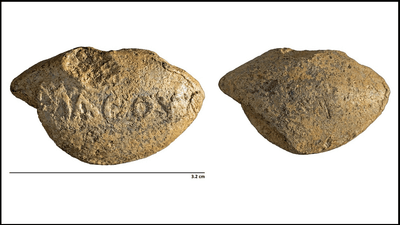
“This paper introduces a unique inscribed lead sling bullet (slingshot) found at Hippos of the Decapolis in 2025,” begins a newly published work from archeologists at the Universities of Haifa, Israel, and Cologne, Germany. “The bullet, most probably launched by the city defenders at attackers coming up the road, carries Greek letters ΜΑΘΟΥ […] a sarcastic imperative addressed to the enemy: ‘Learn your lesson!’”
It’s a small thing: a football-shaped projectile just 3.2 centimeters (1.26 inches) across, almost indistinguishable from any other piece of rubble. But a closer inspection reveals details that speak to both a political story and a personal one: it’s cast from lead, fired most likely in defense of the city during one of its many sieges – and whoever made it evidently wanted to send a message.
“Sling bullets […] were the most common munitions in the Hellenistic world,” Michael Eisenberg, an archaeologist at the University of Haifa and coauthor of the paper, told The Times of Israel this week. “They were the cheapest ones, simple and very effective.”
And while decorations on the projectiles weren’t the norm, they were far from unusual, he said. “In the larger Israel-Syria region, many times you will see a group of thunderbolts tied up together as the ultimate weapon of Zeus, the head of the Greek pantheon,” Eisenberg explained. “Sometimes [there’s] a trident, the weapon of [god of the Sea] Poseidon.”
But actual inscriptions of words are “very rare,” he said. Indeed, of the 69 lead sling bullets discovered at Hippos, across 26 years of excavations, this is the first to carry a message of some kind. And even within this smaller group, the bullet is unusual: “Alongside deity names, military unit names, names of cities, and acclamations of victory, sling bullets mostly bear personal names,” the paper points out, “often […] of the shooter or commander, inscribed on both sides.”
Now, it’s possible that’s the case here – the name in question would be Mαθος, or Mathos. But there are only two known examples of that name in history, and neither is from the time nor the place that the bullet was found. That eventuality, the paper concludes, “seems improbable”.
Far more likely, deduces the team, is that the inscription is an instruction – the aorist middle imperative of μανθάνω (manthano), to learn. It’s “a very strange [grammatical] structure that only exists in Greek,” Eisenberg explained – but it adds up to a simple and vehement message: “LEARN!”
“Perhaps the idea was [to tell the enemy], ‘Learn your lesson’,” Eisenberg said, “or ‘Next time, you should learn not to come here’.”
It’s not the first sling bullet ever found with a message like this. Projectiles have been found in Tell Iẓṭabba, the site of another ancient Hellenistic city that saw its fair share of battles, which are inscribed with instructions to “taste!” or “take!” the munition; in Greece and Turkey, bullets have been found directing their victims to “take it!” and “receive this!”
Still, this marks the first time a bullet has been found bearing education for its recipient – and one thing’s for sure: the lesson took.
“We don’t know if it was a rock or a person,” Eisenberg said, “but there was definitely an impact.”
The paper is published in the journal Palestine Exploration Quarterly.



 2
2