Humans
 PUBLISHED




Agriculture changed the human story forever, jetpacking our species into an era of unprecedented growth and complexity. But the shift from wandering hunter-gatherer to settled farmer didn't happen overnight, and researchers are still piecing together how it unfolded. In a new study, a remarkable collection of 15,000-year-old clay artifacts may offer a rare window into that pivotal period.
An international team of archaeologists, led by the Hebrew University of Jerusalem, has uncovered the earliest known clay ornaments in Southwest Asia. The collection — 142 tiny beads and pendants — was crafted out of clay around 15,000 years ago by the Natufian culture, a group of hunter-gatherers who inhabited the Levant, a region spanning present-day Israel, Palestine, Lebanon, Jordan, and Syria.
This culture was one of the first in the world to settle permanently in one place, millennia before the rise of farming. Living within the transition between paleolithic hunter-gatherer life and the emergence of permanent agricultural societies, they are of enormous interest to researchers trying to understand how and why the Neolithic Revolution happened around 12,000 years ago.
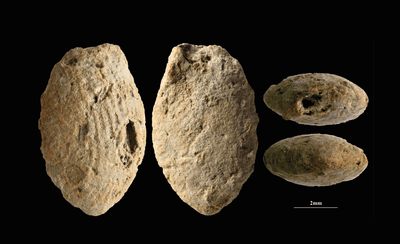
And the seeds of that revolution, it seems, were already taking hold in the minds of the Natufians. Among the 142 ornaments, researchers identified 19 distinct bead shapes modelled on plants that were central to their way of life: wild barley, einkorn wheat, lentils, and peas — the same crops that would later be domesticated and sustain civilisation.
“These new shapes, which emerged at the dawn of village life when wild plants were intensively gathered, suggest that plants were also important in the symbolic sphere of early villagers,” Dr Laurent Davin, leader of the project and archaeologist from the Hebrew University of Jerusalem, told IFLScience.
. In the earliest villages of humanity, .jpg "Elliptical clay beads imitating the shape of cereal crops.")
“It seems that plants – and particularly those that would be domesticated a few millennia later during the Neolithic – played an increasingly important role in shaping the identity of early villagers. In relation to the Neolithic transition, this suggests that the origins of this long-term phenomenon lie in the emergence of the sedentary lifestyle within the Natufian culture,” he added.
The findings resonate with the ideas of archaeologist Jacques Cauvin, who argued that a spiritual and cognitive revolution in human thinking preceded — and perhaps caused — the agricultural revolution itself. Instead of the shift to farming being driven by practical necessity or changes in the environment, Cauvin believed it was triggered by a deeper development in how people understood themselves and their relationship to the world.
“If we follow Jacques Cauvin's theory of the Revolution of Symbols, the idea is that a spiritual transformation led Neolithic communities to perceive themselves as more and more distinct from nature and therefore able to control it,” Davin explained.
“The discovery of the emergence of clay ornaments, along with all other techno-symbolic innovations related to Natufian ornamental practices, demonstrates that the shift to a sedentary lifestyle profoundly transformed the way prehistoric communities constructed, expressed, and asserted their identities.”
Many of the small beads are coated in red ochre using a technique known as engobe. According to the researchers, it's the earliest known use of this coloring technique ever found in the world.
Remarkably, at least 50 fingerprints have been preserved in the clay ornaments, allowing the researchers to identify who made them. This showed that the objects were crafted by adults, as well as adolescents and children. This, the researchers say, might show us how the Natufians passed on their culture and social values from one generation to the next.
The new study is published in the journal Science Advances.