Humans
 PUBLISHED




Researchers believe they have found the earliest evidence of human ancestors butchering and possibly eating each other, dating back around 1.45 million years. The bone of an ancient human species displayed chop marks that were incredibly similar to those created by stone tools, suggesting ancient populations were even more brutal than previously thought.
“The information we have tells us that hominins were likely eating other hominins at least 1.45 million years ago,” author Briana Pobiner said in a statement.
“There are numerous other examples of species from the human evolutionary tree consuming each other for nutrition, but this fossil suggests that our species’ relatives were eating each other to survive further into the past than we recognized.”
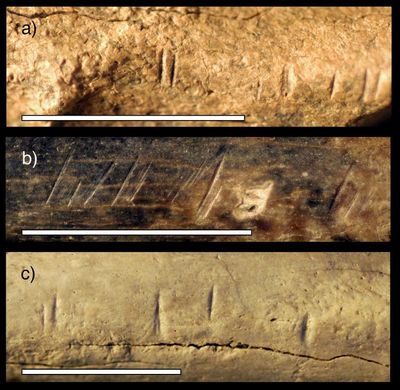
The study examined a fossilized shin bone from the collection of the National Museums of Kenya’s Nairobi National Museum, on which they were looking for telltale marks of predators. The researchers, from the Smithsonian’s National Museum of Natural History, were originally hoping to learn more about the types of predators that were preying on ancient humans, but found something else entirely.
With a magnifying glass, Pobiner identified what looked like evidence of butchery instead of bite marks adorning the tibia, suggesting that this human was chopped up by a tool. To check, the team made a cast of the marks and entered them into a large database, before comparing them to other marks of predation or trampling through a series of experiments.
In total, nine out of the 11 marks looked at were consistent with stone tools, while the other two were thought to be bite marks from a lion-esque big cat, likely a saber-toothed cat. Taking a closer look at where the tool marks were, they were around the areas where the muscle met the bone in a consistent direction, as if someone was sat chopping the meat from the bone. According to the researchers, it looks a lot like marks from humans being processed for consumption.

Of course, it is impossible to truly tell whether they were eaten – they could have been chopped up for display or burial, instead. However, it looks highly likely that whoever owned that tibia met a grisly end and may well have been eaten by other humans.
“These cut marks look very similar to what I’ve seen on animal fossils that were being processed for consumption,” Pobiner said.
“It seems most likely that the meat from this leg was eaten and that it was eaten for nutrition as opposed to for a ritual.”
It is also not necessarily cannibalism, even if the human was eaten, as it is unclear exactly what species of hominin they were. For it to be classified as such, it would need to be proven that the eaten and eater were the same species, which is not possible at this time.
What it does prove, though, is that there continue to be some real gems hidden in museum collections, still waiting to be found.
The study is published in Scientific Reports.