Culture and Society
 PUBLISHED


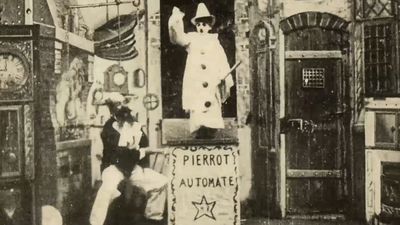


A man in Michigan has discovered a rare copy of Gugusse and the Automaton, a 45-second black and white film by Georges Méliès, a late 19th-century French filmmaker. The short slapstick film depicts the first on-screen portrayal of a robot.
The film was one of 10 found in an old, battered wooden trunk that belonged to the great-grandfather of Bill McFarland, who lives in Grand Rapids, Michigan. McFarland had no idea what was on the nitrate films, but he believed they deserved more attention than he could give them.
“It was just this trunk of films that seemed too good to throw away,” McFarland explained to Agence France-Presse (AFP) France 24. “But I had no idea what they were or how to show them.”
He had tried to sell a few through an antique store and also offered them to museums, but he had no luck. The antique store actually refused to take them after learning that nitrate films were extremely combustible. Nevertheless, McFarland persisted with his search for a home for these century-old artifacts from early cinema and eventually donated them to the US Library of Congress, having driven them from Michigan to the Library’s National Audio-Visual Conservation Center in Culpeper, Virginia.
“The moment we set our eyes on this box of film, we knew it was something special,” George Willeman, the Library of Congress’s nitrate film vault leader, said in a blog post.
The reels had been pretty neglected over the decades, having been moved from attic space to basements and barns over the years. Some were misshapen, while others were either degraded or stuck together. But with some effort, library staff were able to look through the footage, frame by frame.
During the examination, they found a scene where a magician was having a fight with a robot. The librarians were looking at an extremely rare copy of Gugusse and the Automaton, a long-lost film by Méliès that was created around 1897.
Méliès, an actor and magician, turned to filmmaking after seeing the Lumière brothers’ world-first motion pictures in Paris a few years earlier. He was inspired by the technology behind them – a camera that rapidly projected still images onto a screen, making them look like they were moving in real time.
He decided to make his own camera and studio in Paris, where he slowly developed tricks to make increasingly sophisticated films. In particular, he pioneered techniques like double exposure, black screens, and forced perspective.
Although this particular film is less known, Méliès other work is iconic for its surreal sci-fi performances. For instance, anyone familiar with early film history probably knows of his 1902 film, A Trip To The Moon, with its iconic depiction of a man-faced Moon with a rocket stuck in its eye. Méliès was clearly a devotee of science fiction, especially the work of Jules Verne and H.G. Wells, which seems to have informed his creation of a film depicting a fantastical trip to the Moon (via a cannon-fired capsule) that resulted in human astronomers being captured by – and then capturing in turn – lunar inhabitants.
In contrast to this large-scale production, Gugusse is a much more modest film. It shows a painted screen designed to look like a workshop where clocks and automatons were being created. On a stand in the middle is a clown-like automaton that is being wound up by a magician – Méliès. At first, the clown moves jerkily, but it then starts to beat up the magician with a stick.
The magician fights back, crushing his creation with a mallet, each hit seeming to shrink it into a smaller version of itself until it is nothing but a small doll. Finally, he crushes this too, causing it to disappear entirely.
Despite his early achievements, the film industry moved on without Méliès. But his films remained in circulation, often as pirated duplicates in private collections.