Humans
 PUBLISHED


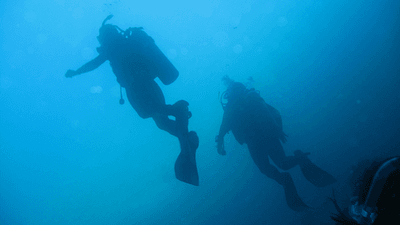


Researchers conducting dives off the coast of Western France believe they have found an ancient, human-made structure, dating back around 7,000 years.
In 2017, retired French geologist Yves Fouquet was looking at charts of the ocean floor around Sein Island that had been produced via laser mapping. To Fouquet, the formation – stretching 120 meters (394 feet) across the sea floor – looked human-made, and at least worthy of investigation.
"Just off Sein I saw this 120m line blocking off an undersea valley," Fouquet told BBC News, adding, "it didn't make sense from a geologic point of view."
In 2022, a team of archaeologists began to investigate, though their initial dives were hampered by seaweed that made mapping the structure troublesome. Conducting dives through to 2024, the team first confirmed that the structures were really there, finding the 120-meter wall, dubbed TAF1, alongside around a dozen other human-made structures.
"The most remarkable discovery is the presence of numerous vertical monoliths and slabs erected on the summits of TAF1 and TAF2A," the team writes. "In the best-preserved areas, the monoliths form two parallel lines spaced ca. 1.5 m [5 feet] apart."
According to the team, there are no known similar finds at these depths in Western France. The large structure is thought to date to around 5,800 and 5,300 BCE in the transition from the Mesolithic period to the Neolithic period, when the sea levels in the area were significantly lower than they are today. According to the team, it may even predate the first megalithic structures found elsewhere, and by several centuries, if confirmed.
But they do have a few ideas about what this ancient structure is, and what it was for. According to the team, it is either a clever trap for fish or designed to protect the shore from the ocean. When it was first created, it was likely under the sea at high tide and out of it at low tide.
"There are architectural similarities between these structures and the fish weirs described in the Molène archipelago, 40 km [25 miles] north of Sein Island," the researchers note, adding that the Sein find was far grander in scale, and more elaborate, taking into account the forces of the ocean.
"The dissymmetry and width of TAF1 suggest that stone was deliberately added to reinforce the structure's resistance to the hydrodynamics of the north side, which is exposed to the swell," the team adds.
According to the team, if it is a fish trap, it is likely that it was in use for several centuries, with extra blocks placed at the site seen as evidence of later maintenance of it. It is a little on the large side for a fish trap, however, with a protective role also considered possible by the team, though less likely.
In a fun, though far more speculative addition, the team links the find to an old Breton legend of the sunken city of Ys, supposedly 10 kilometers (6 miles) to the east of the site.
"It is likely that the abandonment of a territory developed by a highly structured society has become deeply rooted in people's memories," they write. "The submersion caused by the rapid rise in sea level, followed by the abandonment of fishing structures, protective works, and habitation sites, must have left a lasting impression."
More study is needed to confirm the discovery and investigate it further, however, before we get too excited about legendary lost cities.
The study is published in the International Journal of Nautical Archaeology.


 8
8