Space and Physics
 PUBLISHED



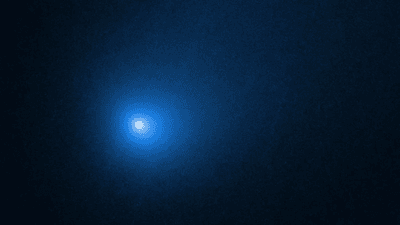


For a long time, interstellar objects were considered theoretical, with no observations to back them up. Then in a matter of a few years, we had two: ‘Oumuamua and Comet Borisov. This has opened the door on the study of these interstellar objects (ISOs) and researchers have begun to simulate how they move in the galaxy. There should be plenty more for us to encounter.
This new work is led by Dr John Forbes at the University of Canterbury in New Zealand. It builds on the results of co-author Simon Portegies Zwart, who found that whenever a star system ejects these asteroids and comets, they will end up in a stream trailing behind the system.
Over billions of years, under the gravitational influences of stars and gas clouds, these streams will stretch out and wrap around the galaxy. In their paper, awaiting peer review, Forbes and colleagues looked at how these streams interact and how many the Solar System eventually encounters. It’s a lot. They estimate that the number of streams crossed by the Sun and co. is a million or more.
One striking example is that the number of pebbles that make up the bed of a braided river, stretching ~100 kilometers [62 miles], is comparable to the number of 1I/ʻOumuamua-sized objects in the stream of ISOs originating from one star. That's a lot of rocks!
Dr John Forbes
If this in itself wasn’t exciting enough, researchers believe that it might be possible, when we have a large sample of ISOs, to work out if they originated from the same star or the same star cluster. The team called the first "sibling ISOs", and the latter "cousin ISOs".
“We predict that siblings should be distinguishable purely based on the velocity with which they enter the Solar System,” Dr Forbes told IFLScience. “If we see an ISO arriving with a velocity within a few kilometers per second of an ISO we've already seen, that will be a strong indication that they're siblings, though there is still a possibility of a chance alignment – this will be an interesting debate if this scenario plays out!”
Cousins might be more difficult to spot as the velocity spread is large, so with a large sample it might not be certain that the objects are really related. It might be possible that for sibling ISOs, the researchers could work out the star they came from, as ISOs with a common origin are expected to come from younger, less active streams. The key words there being might be possible; there is no certainty.
“It boils down to the fact that typical ISOs that we will see as they pass through the inner Solar System have probably been orbiting in the galaxy for billions of years. We can reasonably expect to trace an orbit back on scales of tens of millions of years, but beyond that we expect perturbations from molecular clouds (which are likely to have since dissipated, since they only live for ~10 Myr) and other things in the Milky Way to alter their trajectories,” Dr Forbes explained.
The team expects that we need at least 100 classifications before the first sibling ISOs are recognized. Current estimates of the number of ISOs we might see within the orbit of Mars are about 30 per year, but there is a large uncertainty. Hopefully, upcoming surveys from the ground like the one conducted by the Vera C. Rubin Observatory or in space by NEO Surveyor will refine it. The number of ISOs out there is large – one estimate puts thousands of them within the orbit of Neptune. But space is vast and they are very difficult to find.
“It's an exciting time to be thinking about ISOs! The Rubin Observatory is gearing up to begin its survey early next year, and we are expecting an unbelievable torrent of data,” Dr Forbes told IFLScience. “Speaking of torrents, we were very happy to realize in this work that we could draw an analogy between ISO streams and the braided rivers of the South Island of Aotearoa/New Zealand. One striking example is that the number of pebbles that make up the bed of a braided river, stretching ~100 kilometers [62 miles], is comparable to the number of 1I/ʻOumuamua-sized objects in the stream of ISOs originating from one star. That's a lot of rocks!”
The braided rivers are called He awa whiria in Māori, and this is also the title of the paper submitted for publication and available on the ArXiv.