Space and Physics
 PUBLISHED



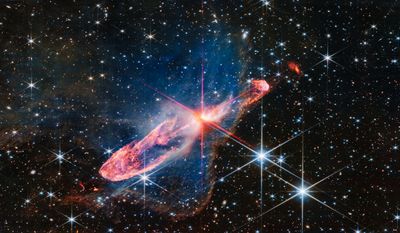


Herbig-Haro 46/47 is a notorious pair of young stars. Over thousands of years, they have pulled in gas and dust left over from their formation and then spewed it out in spectacular jets. The process is far from over: they are continuing to absorb material in the disc they are buried in. The latest observations from JWST provide incredible new insights into not just these objects but star formation in general.
Stellar jets have a fundamental role in how stars grow. These ejections regulate the ultimate size of a star. So understanding their behaviors has a direct link to how much we know about star formation. It will take a few more million years for these two stars to be fully formed.

The pair has been a well-known target for decades but JWST’s capabilities are revolutionary on this object. The faint blue cloud that surrounds the system is actually completely black in visible light. But infrared allows you to see right through it, seeing inside the system and also beyond with the light of distant stars peering through.
Obviously, the crucial observations are the jets and the material they have shot out over thousands of years. The orange ones are the oldest ejection with the most recent one being a very light blue just around the diffraction spikes from the stars. The full extent of the jets is about 10 light-years, very impressive considering that the closest star to the Sun is just over 4 light-years away.
One feature you can’t see is the disc from which they are stealing material. But you can see its shadow cast upon the material that surrounds these fledgling stars. They are located 1,470 light-years away.