Space and Physics
 PUBLISHED
 3
3


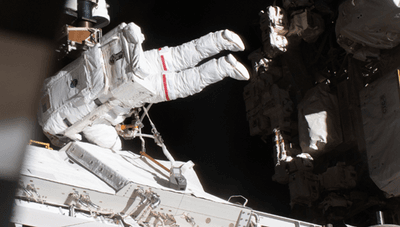


Last week astronauts dropped a toolbag while repairing external parts of the International Space Station (ISS). As we reported, the bag has been picked by trackers of space junk under the code 58229/1998-067WC, and its orbit calculated. It turns out there is more to the story, however, because you don’t need a high-powered telescope to see it, just darkish skies and a pair of binoculars.
The toolbag is tiny compared to the ISS, but it’s reflective enough that when it catches the Sun’s light it reaches 6th magnitude from Earth according to Earthsky. Under very dark skies, people with excellent eyesight can see down to 6th magnitude, but you need everything to be going right. On the other hand, even a small pair of bird-watching binoculars could be quite sufficient to make it out away from city lights, and more powerful binoculars or a small telescope should be sufficient even from the outskirts of a city.
The bag is moving at almost exactly the same speed as the ISS on the same path and about a minute ahead of it. Although it’s expected to remain visible for a few months before its orbit becomes low enough that it burns up from friction with the outer atmosphere, the distance from the ISS will grow, making it harder to find.
Consequently, if you’re lucky enough to have the ISS passing overhead around dusk or dawn soon, something you can find out here, it’s best not to waste your chance. The ISS’s current orbit is good for sightings in North America this week if you’re an early riser.
The ISS can only be seen easily when it’s dark on the ground, but sunlight is still (or already) catching it thanks to being more than 400 kilometers (248 miles) above the Earth’s surface. That means it’s usually best seen when the skies are not fully dark, even if you can avoid the effects of artificial lighting.
Naturally, lingering twilight makes it harder to see a 6th magnitude object, even when it’s easy to spot something as bright as the ISS. Consequently, you may need either particularly good timing for an ISS passage, when it really is quite dark, or to use a relatively powerful set of binoculars.
Meanwhile, here’s what it looks like from the other direction.
@Space_Station by @JAXA_jp astronaut @Astro_Satoshi EVA #89 lost tool bag ⚒️🛰️cc @AstroJaws @lunarloral @AstroAnnimal#Expedition70 #ISS pic.twitter.com/LSMXL3aQ44— Riccardo Rossi - IU4APB - @AstronautiCAST co-host (@RikyUnreal)
We’re not sure how Flat-Earthers will try to explain this, but maybe we don’t want to know.