Space and Physics
 PUBLISHED




Over the past six months, scientists and armchair astronomers have been abuzz with the news of 3I/ATLAS, but don't let the new kid on the block steal everyone else's thunder. In the past decade, at least two other interstellar travelers have been detected in our Solar System – the first of which was very, very odd, indeed.
1I/ʻOumuamua holds the distinction of being the first confirmed interstellar object detected by humanity within our Solar System. It was first discovered on October 19, 2017 by Canadian astronomer Robert Weryk at Haleakalā Observatory in Hawai'i. At that time, it was about 33 million kilometers (21 million miles) away from the Earth, hurtling at great speeds away from the Sun.
Its name – pronounced oh-MOO-ah-MOO-ah – is a Hawaiian term that loosely means “scout” or “a messenger from afar arriving first", paying homage to the place of its discovery and its far-out origins.
Scientists know ʻOumuamua came from beyond the Solar System because of its hyperbolic trajectory. Unlike comets or asteroids bound to the Sun, its sheer speed and path indicated that it was not gravitationally tethered to the Solar System. The object approached the Sun too fast to have originated within its orbit, which provides strong evidence that it was a true interstellar visitor, just passing through our neck of the galaxy.
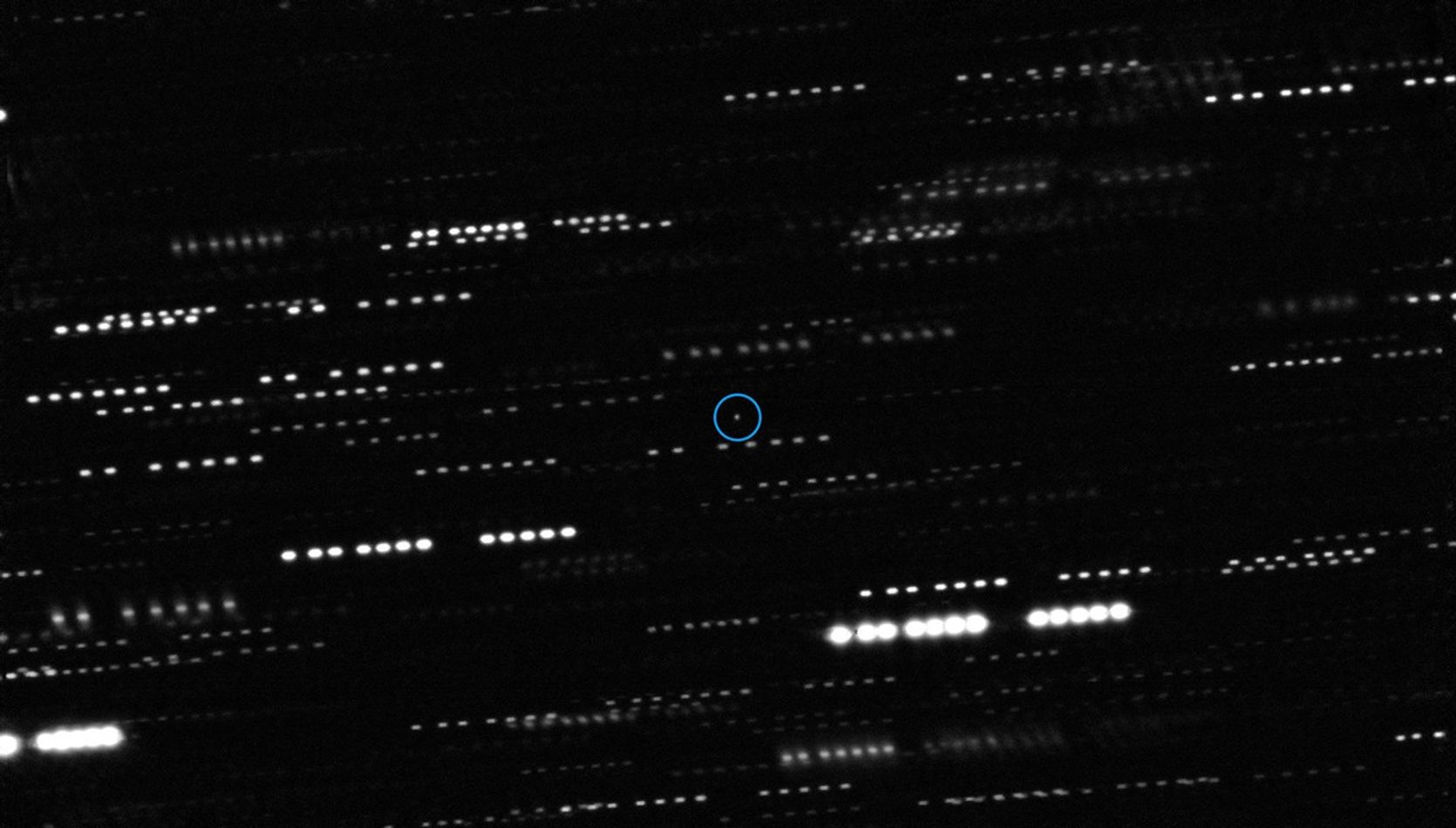
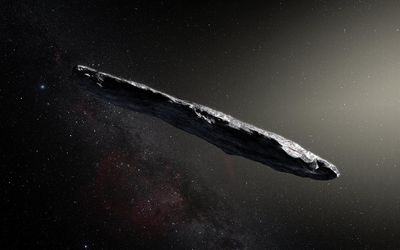
ʻOumuamua is a remarkably strange object, like nothing we had ever seen in our Solar System before. It measures roughly 100 to 1,000 meters (300 to 3,000 feet) long, but what truly sets it aside is its shape.
Most celestial objects, such as planets and asteroids, are round because their gravity pulls material equally from all sides toward their center of mass. However, ʻOumuamua is one of the most elongated cosmic objects known to science, with observations suggesting it is at least 10 times longer than it is wide. Some astronomers believed it might have been disk-shaped, but many suspected it could be shaped like a cigar.
Its spin was also really weird. Rather than a smooth, uniform rotation around a single axis, ʻOumuamua exhibited a "tumbling" motion, or what scientists described as “excited rotational state undergoing non-principal axis rotation.”
And that wasn’t all. As another weird feature, the object mysteriously accelerated as it passed through the Solar System, behaving more like a comet but without any evidence that it was ejecting gas.
These unusual characteristics left many unanswered questions and sparked many people’s imaginations. Similar to the wild ideas floating around 3I/ATLAS, there was a fair amount of speculation that ʻOumuamua was an extraterrestrial spacecraft, like a sausage-shaped mothership.
Unfortunately, or perhaps fortunately, it’s clear this isn’t the case. Its shape and chaotic rotation suggest that it was knocked out of equilibrium long ago, perhaps during a violent event that ejected it from its home star system. One enticing theory was that the object was a shard of a planet that was once ripped apart by a star and sent flying into outer space.
Because of its strong, steadfast trajectory, ʻOumuamua is back on the way out of the Solar System. After its closest approach to Earth in 2017, the passing visitor is currently around 7.73 billion kilometers (4,809,811,342 miles) away from us, a distance so vast it would take light 7 hours and 10 minutes to travel there.
Our celestial neighborhood has had other interstellar visitors since, though. In 2019, an amateur astronomer spotted 2I/Borisov, and in 2025, came 3I/ATLAS.
Considering astronomers spotted three of these objects in just eight years or so, it suggests they’re actually surprisingly common. According to one study, there could be several thousand ‘Oumuamua-sized interstellar objects within the orbit of Neptune at any given time – it’s just a matter of having the technology, time, and patience to spot them.