Nature
 PUBLISHED


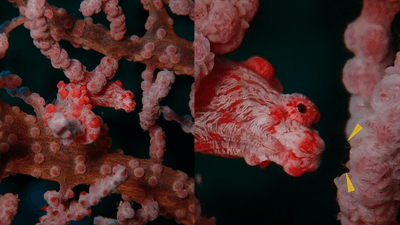


Science is no stranger to discovering species, losing them, and then rediscovering them again, but what’s less common is to realize that the animal you thought you’d misplaced is actually being photographed all the time. Such is the tale of the marine worm, Haplosyllis anthogorgicola, that’s been photobombing seahorses at a rate of three in every four pictures viewed by scientists in a recent study.
They’re pygmy seahorses, to be precise. Adorable, tiny, and oh-so photogenic, so it’s not surprising that citizen scientists have been snapping them across the central Indo-Pacific. What was surprising for the authors of a new study was to discover that when they looked very closely at these pictures, they could spot a worm hiding in plain sight that hadn’t been officially recorded since 1956.
In their paper, The Trojan seahorse: citizen science pictures of a seahorse harbour insights into the distribution and behaviour of a long-overlooked polychaete worm, they document how they spotted the elusive worm hiding in burrows on gorgonian corals. These corals are also a hotspot for pygmy seahorses, which is what gave them the idea to search through a rich portfolio of close-ups on the citizen scientist website, iNaturalist (the worm in this picture is on the seahorse's neck).
“Upon examining those photographs, worms and their burrows were visible in the background, revealing that, despite being unrecorded since its description in 1956, the worm is actually widespread,” explained the authors in a release. “Hence, the charismatic seahorse secretly carried information on the lifestyle of this overlooked and unique worm.”

Part of the reason the worms have gone unnoticed for so long likely comes down to their habitat of choice, which sits at around 15 to 40 meters (49 to 131 feet) below the sea surface, where the conditions are quite turbulent. Getting close enough to spot a miniature worm is therefore easier said than done, but photographs provide the opportunity to take a snapshot and dig into the details when you’re back on dry land, which is lovely and stationary.
The photos that revealed H. anthogorgicola’s great hiding spot have been on the site as far back as 2012, and they could be seen in three-quarters of all photos of pygmy seahorses viewed for the study. Studying the images has revealed new insights into the worms’ range, habitat, and behavior as it often looked like they were beefing with the seahorses, who may have been trying to eat them, or perhaps steal their food.
It just goes to show, then, that you don’t need to be a paid scientist to contribute to the rediscovery of lost species, and that citizen science sites like iNaturalist could have all manner of “lost” species hiding somewhere in the corner of other more conspicuous animals' photos.
Forget Where’s Waldo, we have work to do.
The study is published in the journal Proceedings Of The Royal Society B.

 1
1