Humans
 PUBLISHED
 1
1


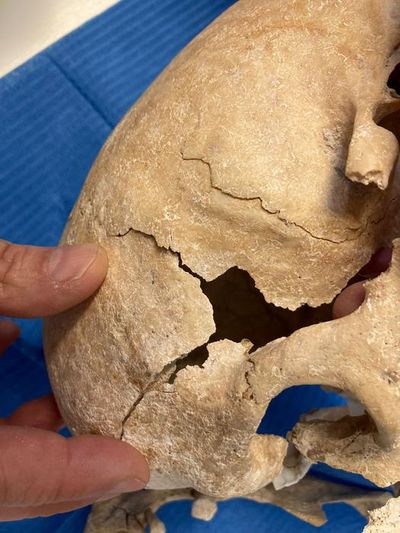


The skeleton of a female warrior who appears to have been slain in battle has been discovered at a cemetery for Medieval knights in central Spain. According to the authors of a new study, the ancient soldieress may have been a member of the Order of Calatrava, which defended the kingdom of Castile from North African invaders between the 12th and 15th centuries.
Researchers made the surprising discovery while analyzing the remains of 25 individuals interred at the Zorita de los Canes castle, which was taken over by the Order of Calatrava in 1174. Located in the province of Guadalajara, the castle stood on the banks of the Tagus River and became a major stronghold for the religious order, which buried its knights within the fortress’s cemetery.
“Most of the individuals display a significant number of penetrating stab wounds and blunt force injuries, suggestive of violent episodes,” write the researchers. “We observed many lesions on the upper part of the skull, the cheeks and the inner part of the pelvis, which is consistent with the hypothesis that we are dealing with warriors," added study author Carme Rissech in a statement.
Interpreting these war wounds, the researchers speculate that the knights may have been killed in the battles of Alarcos in 1195 or Navas de Tolosa in 1212 CE, both of which were pivotal in establishing Zorita de los Canes as the Order of Calatrava’s primary fortress.
Isotopic analyses of the bones also indicated that these slain warriors consumed large amounts of poultry such as red junglefowl, as well as lots of marine fish, despite being based far from any coastline. These findings indicate that the soldiers were all members of the social elite, reinforcing their suspected status as knights.
Astonishingly, however, morphological analysis revealed that one of the 25 skeletons belonged to an infant, while another was a woman. Exactly how the baby ended up in the cemetery is unclear, although isotopic data suggest that the youngster’s mother consumed a high-class diet and may therefore have been connected to the Order of Calatrava.
The adult woman, meanwhile, did not share this rich diet. “We observed a lower level of protein consumption in the case of this woman, which could indicate lower status in the social group," explained Rissech.
And yet, her injuries suggest that she probably participated in battle before being laid to rest with the knights of the order. "She may have died in a manner very similar to that of male knights, and it is likely that she was wearing some kind of armor or chain mail," continued the author.
One hypothesis is that the woman was a servant who was called up to fight and defend the castle, although Rissech is skeptical of this theory since her bones don’t show the kind of wear and tear that is usually seen on Medieval lackeys. In contrast, the woman’s skeleton demonstrates characteristics typical of well-trained warrior monks.
"I believe that these remains belong to a female warrior,” concluded the researcher, who added that the lady of the order would probably have been pretty handy with a sword.
The study is published in the journal Scientific Reports.