Nature
 PUBLISHED


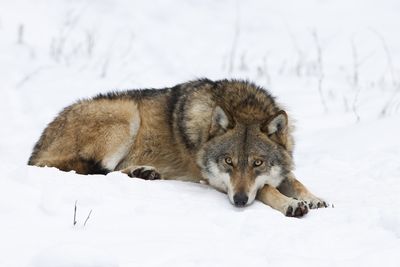


A new study has shown that wolves, just like dogs, recognize and respond to human voices, especially those they are familiar with. This has interesting implications for our understanding of both canine domestication and how species interact.
Many animals can discriminate between members of their species (conspecifics) and recognize familiar individuals by sight, smell, or sound, among other cues. However, evidence for the ability to discriminate between members of other species (heterospecific discrimination) is far less common. Yet this ability – to decode cues from other species – has several evolutionary benefits, including the ability to recognize other species' cries of alarm as well as identifying specific individuals living within mixed-species groups.
To date, existing research into heterospecific discrimination has focused on a few wild animal examples, such as primates and elephants, but has mostly concerned itself with domestic animals, such as dogs. Dogs are capable of not only recognizing different people’s voices, but can even detect the speaker’s gender, emotional state, and other vocal information.
As such, a team of researchers wanted to see if gray wolves (Canis lupus) – the closest wild relative to domestic dogs – also had this ability to recognize human voices, which would have significant implications for how we understand the development of modern domestic dogs.
According to Holly Root-Gutteridge from the University of Lincoln, a co-author of the study, there is a longstanding theory that dogs developed the ability to distinguish between human voices as a consequence of selective breeding.
"So we wanted to look at wolves, because obviously nobody has been selecting so that wolves can recognize human voices," she told AFP.
To test this, Root-Gutteridge and colleagues conducted experiments on 24 gray wolves in five zoos and wildlife parks in Spain. The research subjects were made up of both male and female wolves, and they were all aged between one and 13 years of age. All the wolves were born in captivity and were used to humans, especially their keeper. The keepers were responsible for providing rewards and positive interactions with the animals on a daily basis.
Using playback experiments, the researchers set up speakers that played the voices of several strangers saying specific phrases. The wolves would quickly get used to these voices and lose interest in them as they were not useful to them. Then, the researchers played recordings of their keepers' voices (in Spanish, of course), saying things like “Hey, what’s up wolves?” or “Hello little ones, good morning, how’s it going?”
As with your domestic pooch responding to you, the wolves responded with gestures of recognition and turned to the speakers. The researchers then replayed the voices of the strangers, to check that it was not a random response, and found that the animals again lost interest.
But could this just be a coincidence, or perhaps that the wolves recognized specific phrases? Well, to eliminate these doubts, the team then played recordings of the keepers saying random phrases, rather than familiar ones. Once again, the wolves responded to the specific voices, rather than the content.
According to Root-Gutteridge, this is a significant finding. “[C]hances are, lots of species are listening to us and getting to know us as individuals”, she explained.
"If the abilities are that general, it means that animals might be having a lot more cross species interactions than we had thought about before."
The study is published in Animal Cognition.