Space and Physics
 PUBLISHED



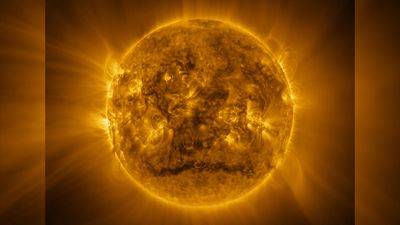


The European Space Agency’s Solar Orbiter is studying the Sun like never before. Just two months ago, it used Venus to leave the plane of the Solar System. It is now on a slanted orbit that will allow the spacecraft to photograph and study the poles of the Sun for the very first time. Before its first skewed close approach that took place on March 31, the spacecraft had time to take a series of photographs, creating the widest resolution image of our star.
Snapped on March 9, the orbiter was 77 million kilometers (48 million miles) from the Sun. It snapped 200 individual images that were put together in this extraordinary view, 12,544 by 12,544 pixels. This is not how the Sun would appear to our naked eye, if we could see it without harm. It was snapped in extreme ultraviolet, which revealed much of the activity happening on the Sun.
There are active regions that in visible light would correspond to sunspots. There are coronal loops stretching from the edge of the Sun as well as prominences; both are streams of plasma shaped by the magnetism of the Sun. And above all, there is the solar atmosphere, the corona glowing due to the extremely hot gas with the occasional dark filament of “cool” material at 10,000 degrees Celsius (18,032 degress Fahrenheit).
“The key uniqueness of Solar Orbiter is two things: First, we get in very close to the Sun, and so we get to study the relationship between the Sun itself and the so-called pristine solar wind. The second thing is that, starting from next year, we actually get to look at the magnetic field of the poles of the Sun,” Dr David Williams, Instrument Operations Scientist for Solar Orbiter, told IFLScience in 2024.
You can check out the full image on the ESA website. It is not the only new image of the Sun coming out this week. The Daniel K. Inouye Solar Telescope in Hawai'i is the world's largest solar telescope, and it has taken some new incredible high-resolution images of the Sun. Together with NASA’s Parker Solar Probe – the fastest human-made object in space – these instruments are letting us study the Sun like never before.