Space and Physics
 PUBLISHED





The measurement of the magnetic moment of the muon has long been a crucial test for the standard model of particle physics, the theory that underpins our modern understanding of the subatomic world.
For decades, experimentalists have disagreed with theorists over its precise value. Key experiments first took place at CERN, and then eventually at Brookhaven National Laboratory on Long Island at the beginning of the 21st century, and they are generally called g-2 (pronounced g minus two) experiments.
The name comes from the g-factor, a figure that represents the magnetic moment. If the universe were simple, the muon’s g-factor would be equal to 2. Unfortunately, the real value depends not only on the properties of the particles but also on the presence of virtual particles that pop in and out of existence from the vacuum.
Theory calculates those interactions and provides a number for the expected value of the g-factor; experiments measure it and provide another number. Ideally, the two should match. But at the end of the Brookhaven experiment, they appeared to disagree with one another.
Classic trope: they are perfect for each other but they live in different cities
If there is some physics beyond the standard model, it might be hiding in the apparent gap between the theoretical and experimental values, but after Brookhaven there was still significant uncertainty in the experimental value.
What was needed was to improve the experimental result with a purer beam of muons. That couldn’t be done at Brookhaven, but it was possible at Fermilab. The problem was that Fermilab was all the way in Batavia, Illinois.
There was a rumor that an alien spacecraft had been shot down on Long Island and had been stored at Brookhaven ever since it had crashed in the 1990s. And then we drive this very cylindrical-looking, saucer-shaped device out in the middle of the night, in the rain
Chris Polly
Fermilab had an accelerator powerful enough to create that purer beam, but it didn’t have a massive electromagnetic muon storage ring like the one at Brookhaven. The team could have, of course, built one from scratch, but it would have been very expensive and taken many years; it was also a bit of a waste given that there was a perfectly functional storage ring in another part of the US.
“At Brookhaven, there had been this magnet designer named Gordon Danby, and he built this beautiful, beautiful storage ring that was basically solely intended to make this type of measurement, because to do this, you need to take muons, you need to put them in a very uniform magnetic field,” Chris Polly, a physicist at Fermilab and co-spokesperson for the Muon g-2 project, told IFLScience.
Danby is also notable for his work on superconducting maglev trains, and the muon storage rings were also designed to create an exquisitely uniform field.
“We just needed a way to get that storage ring from Brookhaven to Fermilab,” Polly continued, “so we could take Gordon Danby's beautiful storage ring and couple it to Fermilab's powerful accelerator complex.”
In the summer of 2013, the ring began this momentous journey.
Moving a giant as gently as possible
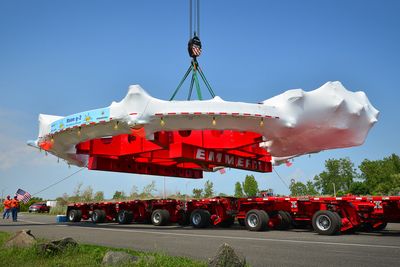
A muon storage ring isn’t a little device. The main piece, which cannot be taken apart, weighs 17 tons, is 15.24 meters (50 feet) in diameter, and the whole structure has coils so delicate that if they were to twist more than 3 millimeters, the whole device would stop working. The relocation needed to be done gently.
Over land, the Brookhaven to Fermilab trip would have been 1450 kilometers (900 miles).
“You can imagine it's very hard to drive [the ring] from New York to Chicago when you hit a two-lane road and you have to take down every stop sign and every stoplight and tree trimming, and so we thought it would be much easier just to fly it by helicopter,” Polly told IFLScience.
“Of course, that never happened, because once reality set in, the rings were way too heavy, the helicopter would have had to set down every 15 minutes to refuel, the vibrations would have destroyed the coils, and so it was just impossible to fly them.”
While watching the news, Polly learned about a company called Emmert International that had experience with moving big things around the US. Together, they came up with a plan for the “Big Move.”
The safest and most cost-effective option was to take the ring on a barge down the east coast, then up the Mississippi river until they got close enough to Fermilab that they could drive the rest of the way.
A tale of UFO crashes and escaping tropical depressions
The team picked the Smith Point Marina as the seaside send-off point for the electromagnet ring. They wanted this to be a public event, so they told people to come and watch as they moved the ring for about 10 kilometers (6 miles) from the lab to the port.
“It was like a place where boats could dock. It wasn't a professional port, so we hired this huge crane that lifted the whole ring and put it on the barge after driving it down these 6 miles of the William Floyd [Parkway], which has some interesting stories there, too…” Polly told IFLScience.
We were not prepared for the rest of that story.
“There was a rumor that an alien spacecraft had been shot down on Long Island and had been stored at Brookhaven ever since it had crashed in the 1990s. And then we drive this very cylindrical-looking, saucer-shaped device out in the middle of the night, in the rain,” Polly continued.
Polly had to assure multiple people that it wasn’t a spacecraft and was just a giant magnet (and then he had to explain that it wasn’t turned on to people wondering why it wasn’t pulling in nearby cars).
After the ring was loaded, the barge and its tugboats started traveling south, taking harbor once in Virginia before facing The Graveyard of The Atlantic in North Carolina. And the sea trouble was just getting started.
“As we were getting closer to the Florida peninsula, there was a tropical depression forming and heading right towards the ring,” Polly told IFLScience. “We didn't want to get caught in one of these tropical depressions or tropical storms.”
“By this time, the barge had rounded the corner of Florida and was coming up through the Gulf, and we called them up and said, 'Hey, can you guys step on it?’”
With a fuel surcharge, they did indeed step on it, escaping the tropical storm that was brewing and safely entering the Mississippi river. The next step was getting to Illinois, where the 5,150-kilometer (3,200-mile) journey would end.
“When the tugboat captain got up to Lemont, that was the closest approach to Fermilab, said he'd never seen anything like it. Every little town he went through, he said, there would be ring watchers out there on lawn chairs cheering this science experiment on its way to Fermilab,” Polly continued.
“We really did a good job getting the PR out. You know, people all along the riverway knew this was happening!”
The final push, an incredible experiment, and accolades
The final 50 kilometers (30 miles) was still a challenge. The ring had to be moved around the Chicago suburbs. They eventually had to shut down two interstates in the Chicago area on separate nights, and the video is iconic.
“I got the privilege of being able to drive the lead car every night and taking groups of scientists with us,” Polly told IFLScience. “How often do you get to walk on the interstates of Chicago? Never, you know? It was cool to have them to ourselves for a little while each night.”
The ring was set up and refurbished, and from 2015 it began collecting data. The experiment concluded last year and measured the g-factor to an unprecedented level of precision. But when it comes to physics beyond the standard model, the question still hangs: while a new theoretical approach agrees with the value from this experiment, it doesn’t agree with other experiments that measure the value in a different way.
Just this week, the Muon g-2 collaboration was awarded the Breakthrough Prize in Fundamental Physics for work on the anomalous magnetic moment of the muon. It’s fascinating to think back on the journey of many decades that led to this point, which somehow includes escaping tropical storms and denying UFO rumors.